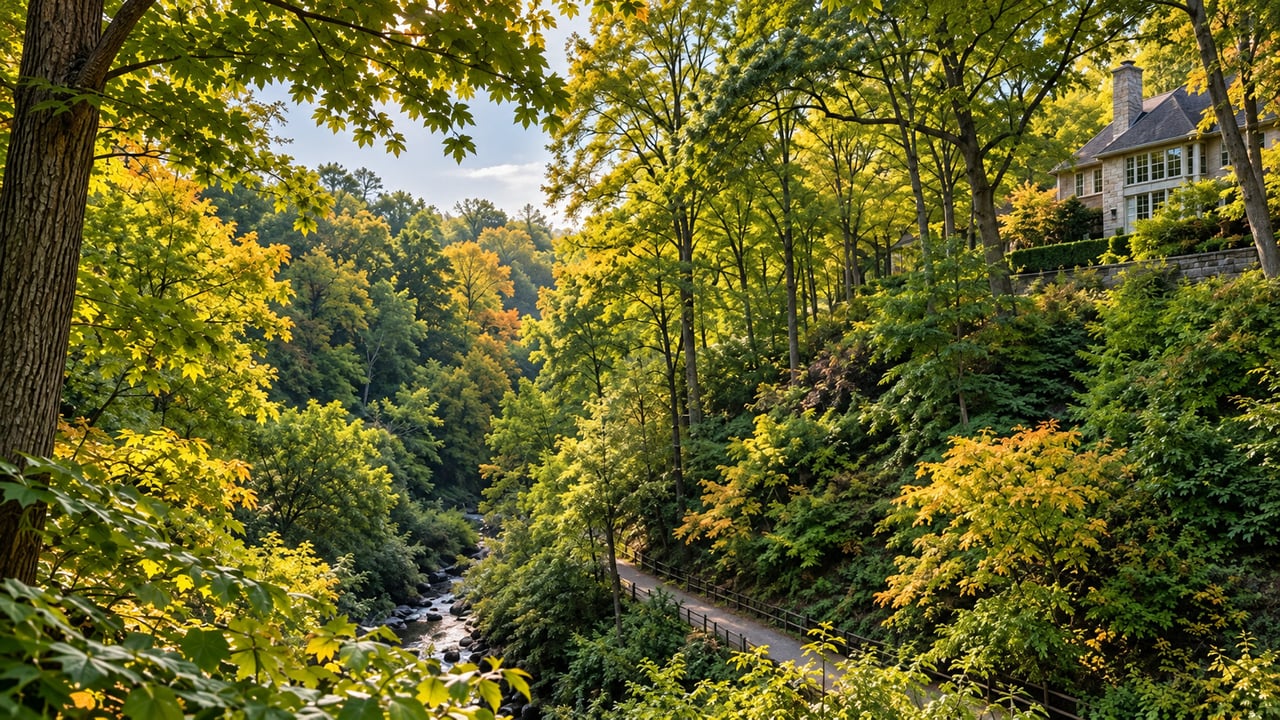
Toronto's ravine system shapes some of the city's most desirable addresses. Here's what makes ravine living distinct, and what to weigh before buying into it.
By Harvey Kalles Team
Toronto is unusual among major cities for how much of its geography is defined by what's underneath the street grid. Woven beneath the neighbourhoods are the ravines, a vast network of forested valleys carved by ancient rivers. They shape the character of the city more than most residents realize. Toronto’s ravines run through some of the city's most established addresses, and for buyers, Toronto ravine neighbourhoods represent something genuinely rare: forested privacy and a direct connection to nature inside a dense urban core.
Understanding what ravine living actually involves, both its appeal and its practical considerations, matters before falling for a listing that backs onto green space.
What Defines Ravine Living?
A ravine property typically backs onto or sits adjacent to one of the city's protected valley systems. This means a forested buffer instead of a neighbour's fence, and a view that changes with the seasons rather than staying fixed. That natural edge tends to bring quiet, privacy, and a sense of scale that's hard to find elsewhere in a city of this size.
The Benefits of Ravine-Adjacent Properties
Beyond the obvious appeal of the view, ravine-adjacent homes tend to hold a distinct kind of desirability. Lots backing onto protected land can never be built on behind you, which insulates these properties from a certain kind of unwelcome change that affects denser blocks. The tree canopy also does real work… cooling homes in summer, buffering street noise, and giving these pockets of the city a quieter, slower feel than their addresses might suggest.
Trails, Parks, and Access to Nature
Many of Toronto's ravines connect directly into the city's trail network, giving residents walking and cycling access to green space that would otherwise require a drive out of the city. Our guide to parks and ravines in Toronto covers some of the best-loved stretches, many of which sit just steps from the residential streets above them.
Neighbourhood Spotlights: Toronto's Ravine Communities
Some of Toronto's most established addresses owe their character directly to the ravine systems running through them. Rosedale is perhaps the best known, with winding streets shaped by the ravine topography itself, and many properties backing directly onto protected valley land.
Moore Park, just north of Rosedale, shares a similar relationship with the ravine system, offering a quieter, more residential feel, while still backing onto the same network of forested valleys.
Lawrence Park sits along its own stretch of ravine, where mature trees and larger lots give the neighbourhood a settled, established character that's become synonymous with long-term Toronto living.
Further north and west, Hoggs Hollow and York Mills sit within some of the city's most dramatic ravine topography with properties that step down toward the valley floor and take full advantage of the elevation. The Bridle Path, known for its estate lots and sweeping properties, is similarly defined by the ravine land that runs through and around it.
Leaside, while slightly removed from the deepest ravine topography, still benefits from its proximity to the broader system, with several parks and green corridors connecting the neighbourhood into the city's larger network of protected valleys.
What to Consider Before Buying Near a Ravine
Ravine living comes with real appeal, but also with a set of practical considerations that don't apply to a standard city lot. Neighbourhood selection for ravine properties matters more than it might for other purchases, since ravine topography can vary significantly street to street, even within the same community.
Purchase premiums and additional costs are worth budgeting for upfront. Ravine-adjacent properties often carry a premium over comparable homes elsewhere in the same neighbourhood, and that premium can extend into ongoing costs as well.
Slope stability and erosion concerns are specific to ravine lots and worth investigating closely, particularly for older properties or those on steeper grades. A geotechnical assessment is often a worthwhile step before finalizing an offer on a ravine-adjacent lot.
Regulatory restrictions and compliance also come into play. Properties near protected ravine land are frequently subject to conservation authority oversight, which can affect everything from fencing to additions. Tree management regulations are a related consideration, since mature trees on or near ravine lots are often protected, meaning removal or significant pruning may require municipal approval even on private property.
Maintenance demands tend to run higher too. A forested lot requires more upkeep than a standard backyard, from managing leaf litter and drainage to monitoring the slope itself over time. And insurance and mortgage considerations are also worth raising early with your lender and insurer, since some ravine-adjacent properties face different underwriting requirements than a standard city lot.
The Long-Term Desirability of Ravine Properties
Despite the added complexity, ravine properties tend to hold their desirability well over time, precisely because the land behind them can't be developed. That permanence is part of what makes these pockets of the city appealing to buyers searching for neighbourhoods for families in Toronto, as well as to buyers simply looking for more green space and quiet in their daily lives.
It also connects to a broader shift in how people want to use their neighbourhoods. Our blog article on the return of the third place touches on this same idea: people increasingly want spaces and neighbourhoods that offer something beyond just a house, whether that's a trailhead at the end of the street or a park within walking distance.
For buyers exploring Toronto's ravine neighbourhoods, working with luxury real estate agents who understand the specific considerations of ravine-adjacent properties, from conservation authority rules to long-term resale patterns, can make the difference between falling for a view and understanding what you're buying.