A Return to Newfoundland at the AGO
When David Blackwood passed away in 2022, Canada lost one of its great chroniclers of place and memory. This autumn, the Art Gallery of Ontario offers a chance to step into the world he documented: rugged, mythic, and intimate. Opening October 8, 2025, David Blackwood: Myth & Legend draws together more than 80 prints, drawings, test proofs and copper plates, along with archival materials, film, and even scent, to show not just what Blackwood created, but how he worked.
Born in 1941 in Wesleyville on Bonavista Bay, Blackwood grew up surrounded by stories of life at sea. Sailors, fishermen, icebergs, and storms formed the visual vocabulary that would define his career. As a boy he filled sketchbooks, and his drawings won him a scholarship to the Ontario College of Art in 1959. There, he studied under John Alfsen, Carl Schaefer, William Roberts and other established Canadian artists, refining his technical skill while holding on to the images of home.
Although he later settled in Port Hope, Ontario, Blackwood returned to Newfoundland almost every summer. These visits gave him the fuel to observe, to remember, and to transform what he saw into images of endurance, tragedy, and myth. This balance of Ontario as home base, and Newfoundland as origin, shaped the emotional weight of his work.
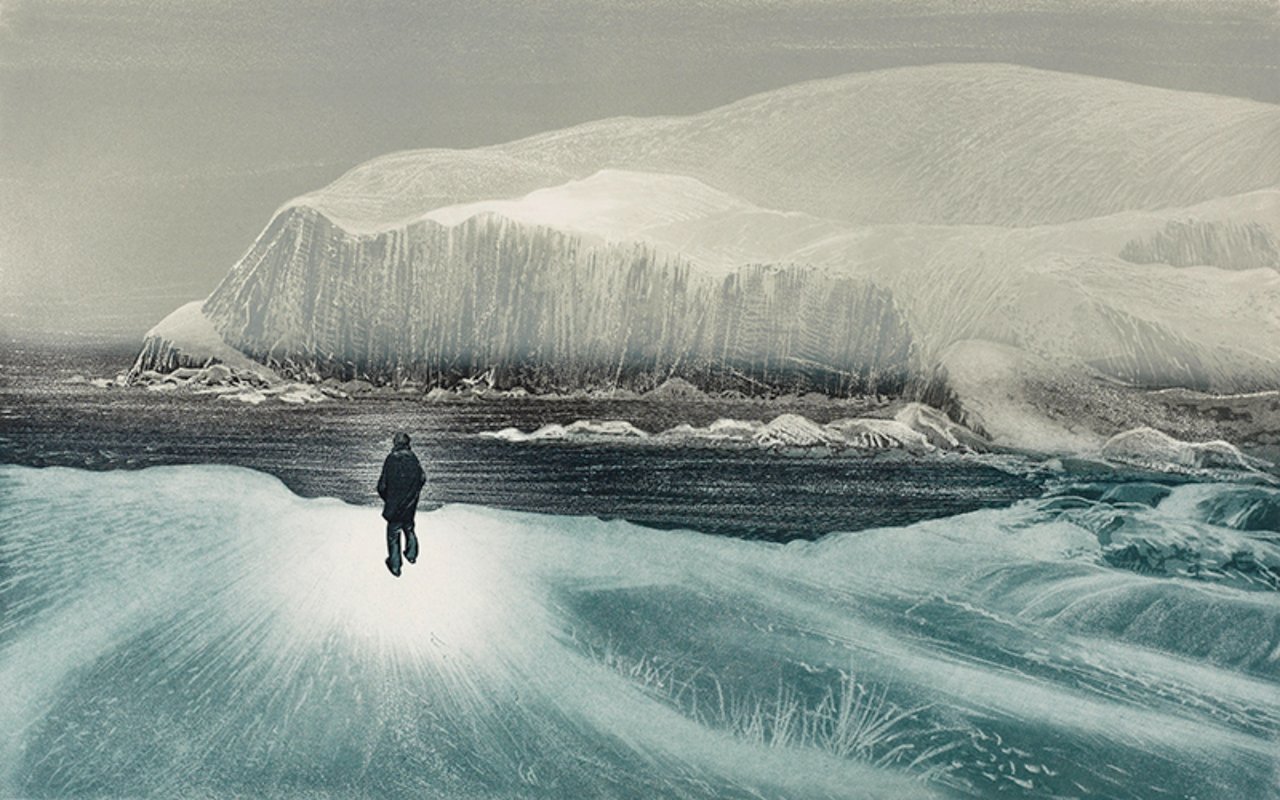
Blackwood’s art is striking for the way technical mastery meets storytelling. Working with intaglio methods such as etching and aquatint, he would carve and incise plates before inking and printing them, often producing multiple states and proofs. His process was exacting and slow, but it allowed him to refine tone, line, and texture with extraordinary precision.
The subjects he chose were often moments of danger and survival: sealing disasters, ships lost to fire, icebergs looming in the dark. Communities living with harsh realities were his central theme. His famous Fire Down on the Labrador (1980) shows a ship engulfed in flames, small boats scattered on the water, figures adrift, and a whale emerging below. It is an image of peril that is both specific to Newfoundland and universally gripping.
What makes his craft so enduring is the way the atmosphere is inseparable from the narrative. The dark skies and vast seas are not mere backdrops, but characters themselves, shaping the fate of those who venture out. Blackwood’s restrained palette of blacks, greys, and muted blues heightens this effect, lending his prints a haunting, almost cinematic quality. The AGO exhibition highlights this process by showing sketches, test prints, and copper plates that reveal how he refined each detail until emotion and technique became inseparable.
Blackwood was named to the Order of Canada in 1993, honoured by several universities, and exhibited across the world. He is firmly part of the Canadian canon, yet his themes feel especially timely. His prints speak to displacement, environmental fragility, and the resilience of small communities confronted with forces larger than themselves. In an era marked by climate anxiety and migration, his images resonate with fresh urgency.
What makes his work particularly powerful is the way it bridges personal memory with collective history. Blackwood was not simply documenting events or landscapes. He was shaping a visual language of survival that reflected the endurance of families and communities bound to the sea. Viewers today may see echoes of their own challenges in his images: the uncertainty of change, the loss of traditions, and the search for stability in a shifting world.
Curator Alexa Greist emphasizes the duality at the core of his art. “No subject inspired Blackwood more than the isolated outport of Wesleyville on Bonavista Bay, where he was born and raised,” she explains. “And while he returned most summers and through his work, I am also excited for visitors to learn about his legacy as an Ontario artist.”
His impact also extends through teaching. He shared his craft widely, first as artist-in-residence at the University of Toronto Mississauga, and later as a longtime teacher at Trinity College School in Port Hope. Generations of students remember him not only as a master printmaker, but as a mentor who encouraged them to pursue their own visions. His influence can still be traced in the work of younger Canadian artists who learned from his commitment to both tradition and innovation.
The exhibition presents more than finished works on walls. It includes the Oscar-nominated 1976 documentary Blackwood, which captures the artist in his studio describing the printmaking process. Archival photographs and personal diaries, begun when he was only age 15, provide an intimate view of his life and creative journey.
Adding to the atmosphere are two custom scents developed for the show. One recreates the aroma of the print studio, while the other evokes the cold salt air of the North Atlantic. The AGO has also commissioned Newfoundland artist Jerry Ropson to create a video response to Blackwood’s legacy, bringing a contemporary perspective to his influence.
Visitors will move through three galleries on the AGO’s first floor. A richly illustrated catalogue will accompany the exhibition, featuring over 80 reproductions and essays by curators Alexa Greist and Amy Marshall Furness. For those interested in exploring the artist’s archive and creative process in greater depth, it serves as an essential companion.
David Blackwood’s work is often described as nostalgic, but it is more than memory. His prints show how the past survives in us, and how stories of hardship and endurance can shape identity. He combined precision with myth to examine not only what was, but what remains.
What sets him apart is the way he drew connections between the particular and the universal. A midwife in Wesleyville, or a ship caught in ice, are not just subjects from a distant past. They are symbols of resilience, sacrifice, and human vulnerability that still feel immediate.
Myth & Legend is both a celebration and an invitation. It invites us to look closely at how an artist built his world, to feel the pull of place and memory, and to reflect on the challenges and resilience of communities tied to the sea. In the quiet strength of his images, there is something enduring: a reminder that art can carry the weight of history while speaking directly to the present.