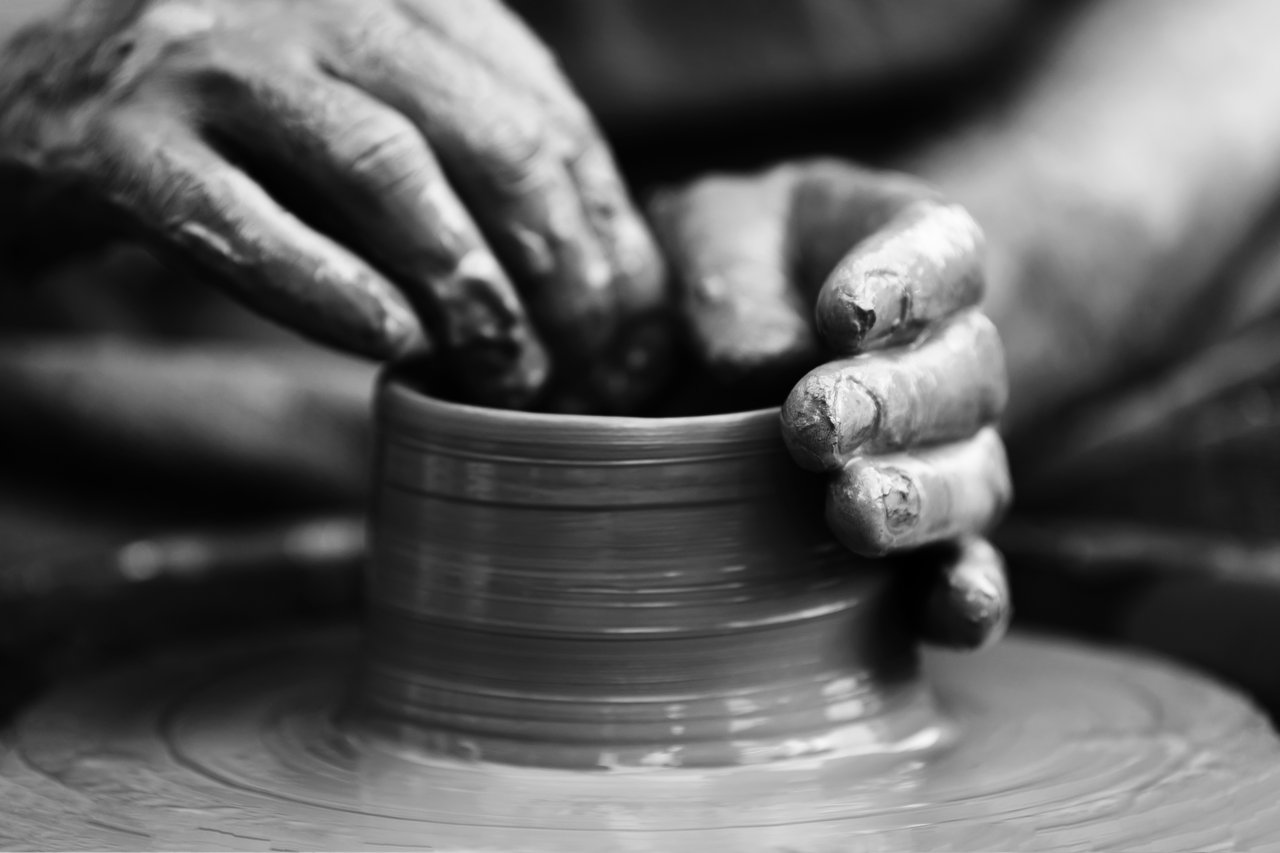
There’s something especially satisfying about making an object with your own hands. It might be the concentration required to centre clay on a wheel, the heat of molten glass, or the pleasure of watching a flat piece of leather take shape. In late fall, a few hours inside a working studio feels like time well spent.
This season, some of Ontario’s most interesting creative experiences are happening at pottery studios, craft schools and museum workshops across Toronto and within road-trip distance of the city. Each offers the chance to learn directly from an experienced craftsperson and leave with something more substantial than a standard craft-class souvenir.
From glassblowing and silversmithing to leatherwork, pottery and paddle carving, here are six Ontario workshops where the finished piece is worth keeping.
1. Playing With Fire Glassblowing Workshops
Where: Artscape Wychwood Barns, Toronto
Why Go: Shape molten glass in a working studio.
Glassblowing leaves little room for hesitation. Once the glass comes out of the furnace, it must be gathered, turned and shaped before it cools. At Playing With Fire, beginners work under the guidance of Finnish-born glass artist Minna Koistinen and her team, learning how heat, gravity and breath transform a glowing mass into a functional or sculptural object.
The choice of projects makes this more than a demonstration with token participation. Depending on the session, students can create drinking glasses, vases, bowls, oil lamps, paperweights or glass ornaments. Each piece must cool in the annealer after the workshop, so it is collected later rather than carried home that day.
Pick your project: Make tumblers, glass balls or vases at public sessions from late October through mid-December. For something more intimate, book a Date Night for two or gather six to nine people for a private workshop.
2. Make an Embroidered Sterling Silver Pendant
Where: Harbourfront Centre, Toronto
Why Go: Combine sterling silver and coloured thread to create wearable art.
harbourfrontcentre.com/courses-workshops/make-an-embroidered-sterling-silver-pendant/
Harbourfront Centre’s Craft & Design Studio hosts this two-evening workshop on November 18 and 25. Under the guidance of facilitator Viyan Petekkaya, participants texture, cut, drill and finish sterling silver before adding embroidery and assembling the components with rivets. No previous metalworking experience is required, and the class is limited to four participants.
The appeal lies in the contrast between the materials. Silver is rigid, reflective and cool; thread introduces colour, softness and visible handwork. The pendant can also be made reversible, allowing each side to carry a different composition. The result is less a prefabricated charm than a miniature piece of wearable design.
Save the dates: This two-part workshop runs from 6:30 to 9:30 p.m., with no makeup sessions. Register at least 48 hours ahead.
3. Private Leathercraft Workshop
Where: NINOX Leathercraft, Toronto
Why Go: Learn leathercraft one-on-one and make something you’ll use
every day.
ninoxleathercraft.com/pages/privateworkshop
NINOX offers private instruction with projects and scheduling tailored to the participant. Most designs shown on the studio’s website can be adapted into a class, including cardholders, wallets, watch straps, notebook covers and bags. Leather makes a particularly satisfying introduction to handicrafts because the finished piece continues to change. A wallet or cardholder softens with use, darkens where it is handled and develops a patina specific to its owner. Learning how to measure, cut, stitch and finish the edges also reveals why a well-made leather object can last for years.
Start small: A cardholder or wallet is an ideal first project. Send NINOX an inspiration photo, and they’ll quote the workshop and find a weekend that works.
4. Private Pottery Workshop
Where: Queenston Pottery, Niagara-on-the-Lake
Why Go: Make pottery in a working Niagara studio that has been shaping, glazing and firing stoneware since 1978.
queenstonpottery.com/experiences
Queenston Pottery’s private workshops accommodate groups of roughly 4 to 16, with projects tailored to the group’s interests and experience. Depending on the session, participants might form mugs or bowls, decorate platters or work on sculptural tiles. The studio team handles the subsequent drying, glazing and kiln firing.
That delay is part of the education. Clay cannot be hurried from wet form to finished object, and a workshop makes the normally unseen stages of production easier to understand. It also offers a welcome change to Niagara’s familiar tasting route, replacing the sequence of pours with an afternoon spent learning what clay will and will not allow.
Good things take time: Pieces are ready in four to six weeks, so ask about shipping. Flying solo? Check the calendar for a Pottery Pop-Up or Clay Club.
5. Carve a Canoe Paddle
Where: Canadian Canoe Museum, Peterborough
Why Go: Carve a black-cherry paddle using traditional hand tools.
canoemuseum.ca/eventcal/carve-a-canoe-paddle-workshop-thurs-fri-dec-10-11-2026
On December 10 and 11, the Canadian Canoe Museum hosts a workshop led by members of its curatorial team. Participants begin with a paddle blank already cut to shape, then work through carving, smoothing and final sanding. No previous woodworking experience is required, and the museum supplies the tools, materials and varnishing supplies needed to complete the paddle at home.
The setting gives the project unusual depth. The museum stewards more than 650 canoes, kayaks and paddled watercraft, making it possible to study how blades, shafts and grips vary according to use and tradition before shaping a contemporary paddle of your own. This is not merely a woodworking exercise. It is an encounter with an object refined over generations of travel on water.
The payoff: Come spring, test your new paddle on Little Lake after the two-day workshop.
6. Small-Group Wheel Workshop
Where: Muskoka Bay Pottery, Gravenhurst
Why Go: Learn the physical rhythm of throwing clay
muskokabaypottery.ca/pottery-classes-and-workshops/
Muskoka Bay Pottery offers weekly beginner and intermediate instruction for one or two students, along with two-to-three-hour workshops for small groups. The intimate format gives the instructor time to correct the details that determine whether a vessel rises or folds.
The trip becomes more interesting once Muskoka has emptied of its summer traffic. Bare granite, cold water and early dusk replace the familiar dock-and-canoe imagery. Inside, the wheel demands enough concentration to make a few hours disappear. The objective is not instant mastery. It is the pleasure of seeing a usable form emerge from a lump of clay.
First spin? New to the wheel? Choose the longer small-group workshop. The shorter lessons work best as an eight-class series.
From a glass furnace at Wychwood Barns to a pottery wheel in Muskoka, and a paddle-carving bench in Peterborough, these workshops prove that making something yourself changes how you see the finished object. The value lies not only in what comes home, but in understanding the skill and patience behind it.
A handmade piece may carry an uneven edge, a visible stitch or a slight wobble in its shape. Those details are what separate it from something purchased from a store shelf. They recall the heat of the studio, the resistance of the material and the moment the object began to take form.
Late fall is a good time to work a little more slowly. What you make might remain with you long after the season changes.