Before the Beatles became mythology, before the merch, the documentaries, the endless cultural recycling of mop-top hair and stadium screams, there were just four young men moving through unfamiliar cities at an impossible speed. The world was changing around them, and they were changing it right back.
At the Art Gallery of Ontario, Paul McCartney Photographs 1963–64: Eyes of the Storm captures that exact moment of detonation. Opened at the AGO in February, the exhibition presents more than 250 photographs taken by McCartney during the band’s earliest rise, when they went from British pop sensations to global superstars in what feels like a single breath. The result is not a nostalgia show or a fan shrine. It is a portrait of a cultural before-and-after, shot from inside the machine.
The exhibition’s smartest move is also its simplest: it asks visitors to look at McCartney not as a musician, but as an observer. Someone paying attention and documenting.
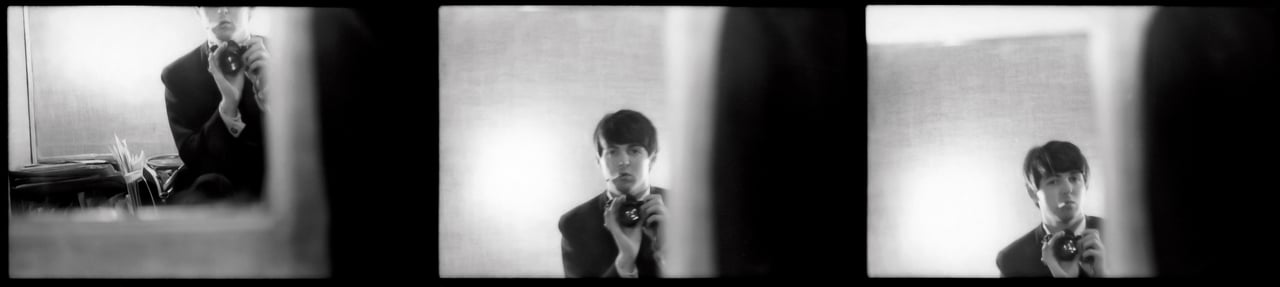
In Paul McCartney, Self-portraits in a mirror, Paris, January 1964, that idea comes into sharp focus. McCartney is not only performing for the world, he is also watching it. The self-portraits feel less like publicity images and more like a private act, as if he is testing the camera, testing the frame, and quietly registering that something is about to happen. In a world now addicted to constant self-documentation, the photographs lands with unexpected force. It’s not a selfie. It’s an artist clocking his own reflection before fame turns him into a symbol.
The title of the exhibition, Eyes of the Storm, is perfectly chosen. Beatlemania was not just noise…it was a cultural weather system. The photographs capture that strange tension between frenzy and stillness, between the chaos outside and the quieter, almost surreal reality inside.
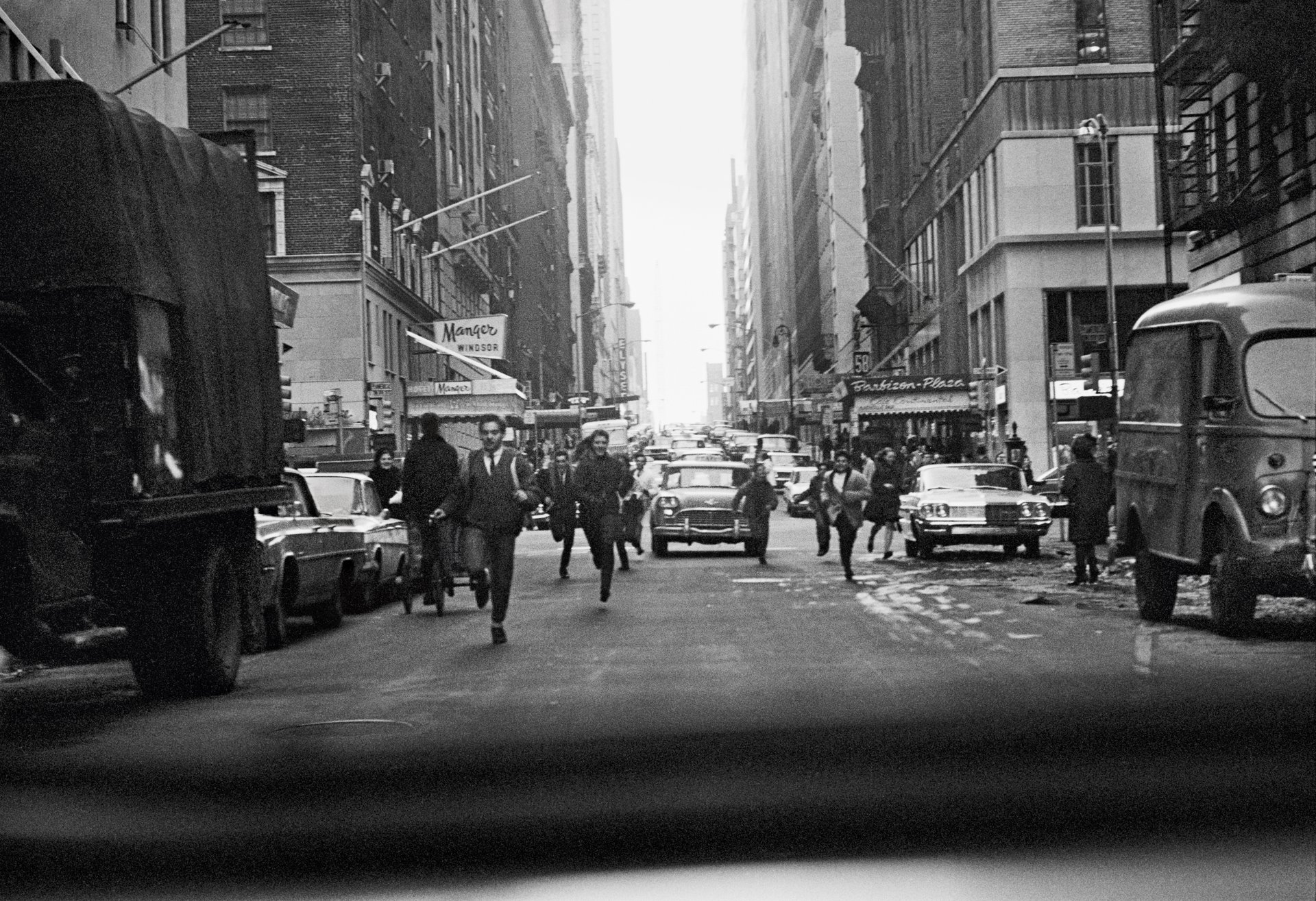
Paul McCartney, West 58th Street, crossing 6th Avenue. New York , February 1964 © 1964 Paul McCartney under exclusive license to MPL Archive LLP.
That sense of velocity is unmistakable in Paul McCartney, West 58th Street, crossing 6th Avenue. New York, February 1964. Shot from inside a moving car, the photograph catches fans and media racing alongside, the frame tilted with intensity. McCartney captures Beatlemania as it spills into the street. There’s exhilaration in the image, but also a hint of how quickly excitement can turn into something relentless.
In Paul McCartney, Photographers in Central Park. New York, February 1964, McCartney turns the camera away from the band and toward the people trying to capture them. It’s an image that feels incredibly modern. The Beatles are not the only spectacle. The photographers, gathered and aiming their lenses, become a symbol of what celebrity culture was becoming: a relentless cycle of documentation and desire. It is almost funny, until you realize how much of today’s fame economy is still built on that exact dynamic.
McCartney’s eye is sharpest when he focuses on the in-between moments. Not the performance, but the pause. Not the screaming crowds, but what happens just before the door opens.
In Paul McCartney, John Lennon, Paris, January 1964, Lennon appears not as a finished icon but as a real person caught mid-thought. The photograph carries the weight of hindsight, because we cannot look at Lennon without knowing what comes later. But McCartney’s lens strips away some of that inevitability. This is not Lennon as legend. It’s Lennon as a young man, existing in the middle of a whirlwind that hasn’t yet fully swallowed him.
That intimacy extends to Paul McCartney, John and George. Paris, January 1964, an image that feels like a glimpse behind the curtain. It’s a reminder that for all the frenzy and spectacle, the Beatles were still, at their core, a group of friends navigating the same rooms, the same long days, the same exhaustion. What makes the photograph compelling is its casualness. It doesn’t feel staged. It feels like McCartney catching a moment that might otherwise disappear.
Then there’s Paul McCartney, Ringo Starr. London, January 1964, which offers another kind of closeness. Starr is often treated as the band’s comic relief in the Beatles narrative, but McCartney’s photograph feels more grounded. There is a calmness to it, a sense that the camera is being held by a friend, not a journalist. The image suggests that for all the screaming and spectacle, the Beatles were still living in close quarters, still navigating the intensity together.
The show also reveals how deeply fashion was baked into Beatlemania. The Beatles didn’t just change music, they changed the silhouette. Their suits were precise, youthful, and instantly recognizable, offering a clean new uniform for a generation that wanted to look modern. It’s easy to forget how radical that was at the time. Style became part of the sound.
In Paul McCartney, Self-portrait. London, 1963, McCartney leans into that self-awareness. The mirror framing makes the photograph feel like a rehearsal for modern celebrity culture, where identity is something you curate, adjust, and capture.
The exhibition also plays with the strange speed at which the world decided The Beatles were no longer just people but artifacts. The Beatles with clay portrait busts by David Wynne, 1964 is almost absurd in the best way. The band stands alongside sculpted versions of themselves, as if history is already being cast in real time. It is funny, uncanny, and quietly chilling. Few artists ever witness their own canonization while they’re still young enough to be jet-lagged.
Perhaps the most compelling thing about Eyes of the Storm is that it refuses to treat Beatlemania as a single-note phenomenon. It wasn’t only hysteria. It was also industry, media, image-making, and style. It was the birth of modern celebrity culture, captured before anyone had the language to describe it.
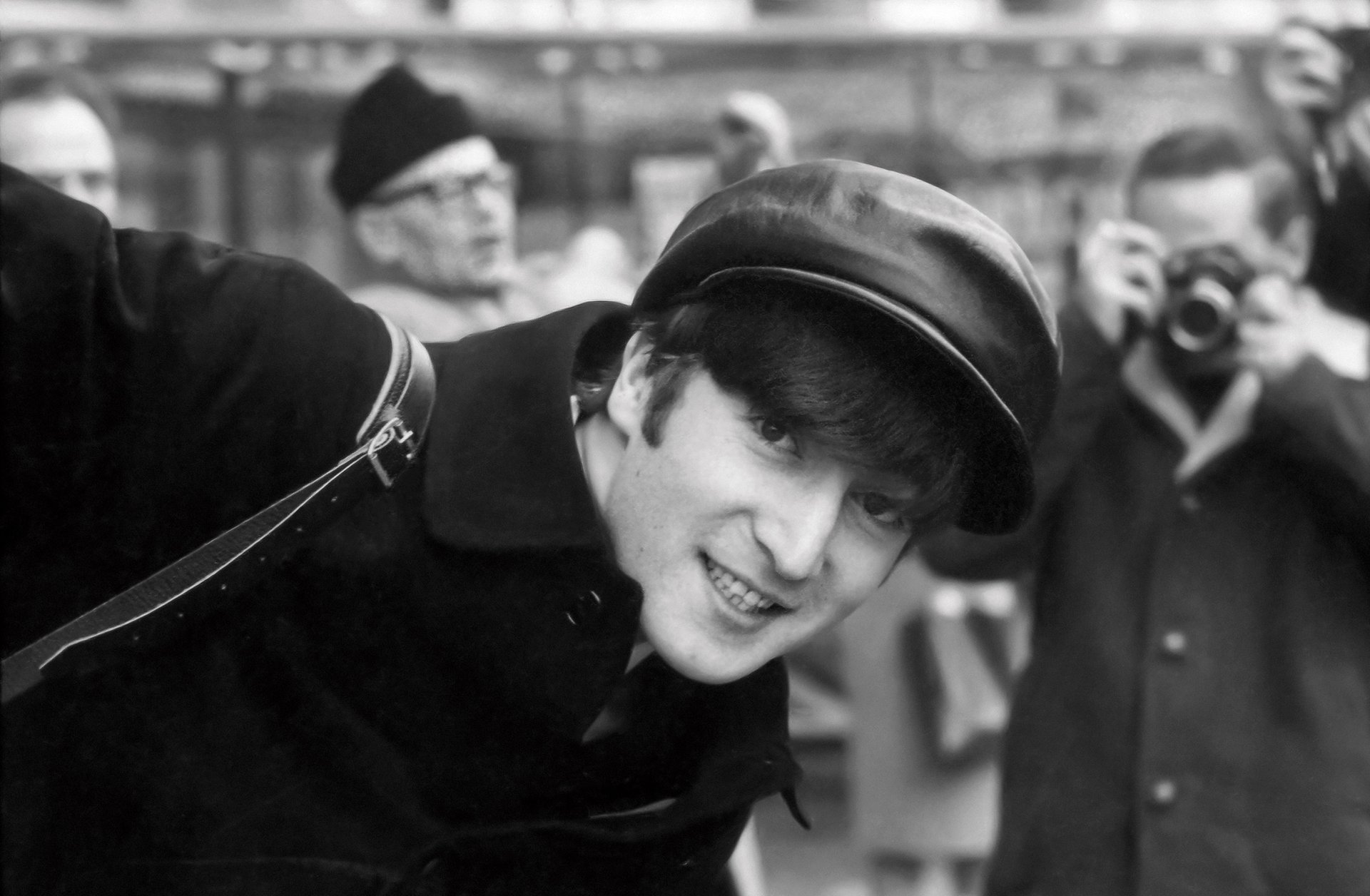
Paul McCartney, John Lennon. Paris, January 1964 © 1964 Paul McCartney under exclusive license to MPL Archive LLP.
AGO curator Jim Shedden puts it bluntly: “There is culture before The Beatles, and there is culture after The Beatles.” McCartney’s photographs make the case visually. The exhibition shows the early 1960s as a moment of acceleration, when music and photography were both shifting rapidly, and when youth culture began to see itself as powerful enough to lead.
There’s a particular satisfaction in seeing these images in a gallery context, where they can breathe. On social media, celebrity photography is disposable. Scroll, like, forget. At the AGO, McCartney’s archive is slowed down and sharpened. You notice composition, mood, and the quiet intelligence behind the camera. You start to understand that McCartney wasn’t merely documenting his life. He was collecting evidence of a new world forming around him.
For Toronto audiences, the show lands especially well because it speaks directly to the intersection the city loves most: music, fashion, and cultural history with a glossy edge. It is a reminder that pop culture is not separate from “real” culture. It is culture, and sometimes it’s the culture that changes everything.
In the end, Eyes of the Storm isn’t really about The Beatles as performers. It’s about what happens when the world starts watching you so intensely that you decide to watch it back.
And McCartney, camera in hand, did exactly that.
On view through June 7, 2026. For more details on how to book your tickets visit AGO.ca.
Title Image: Paul McCartney, Self-Portraits in a Mirror, Paris, January 1964 © 1964 Paul McCartney under exclusive license to MPL Archive LLP.