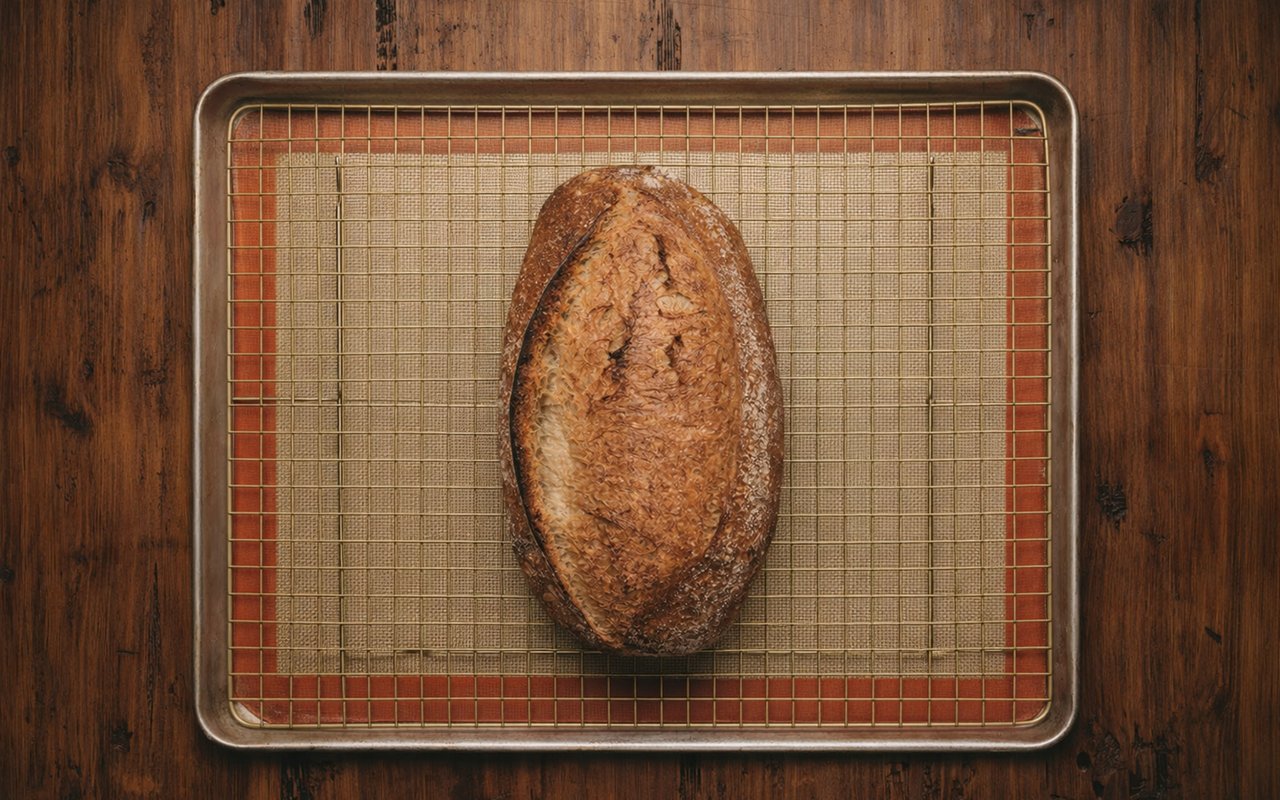
My love of bread really started when I was an apprentice cook. I had no intention of learning how to bake, but slowly became obsessed with the process. There was something so special about the dedication to the starter, the way the dough came together in the mixer, the explosive oven spring, the beautiful shapes and colours, the crackling sounds and, of course, the taste of fresh bread.
At home, I make almost exclusively naturally leavened baked goods. From time to time, I use yeast, but my true passion lies in baking with a sourdough starter. Baking sourdough bread started as a job, then became a hobby that turned into a passion. Now it’s my way of life.
I bake bread with my kids to celebrate food and ingredients and to share time together. Making sourdough can seem complicated, especially with the influx of conflicting information about it, but the process can be very simple. Most importantly, it should be enjoyable!
Although many people shy away from baking sourdough because of a distaste for sour food, sourdough breads should not be overly acidic. Think about a squeeze of lime on tacos… it enhances all the other flavours. The acidity in sourdough that develops during fermentation helps with the balance and harmonizes with the taste of the grains. In general, sourdough breads have a longer shelf life, are easier to digest, and to my mind, taste better than yeasted breads. While it takes much longer to bake sourdough bread than bread leavened by store-bought yeast, it is well worth the wait. I’m excited for you to join me on the journey!
Beginner Sourdough
This recipe is an ideal introduction for those new to sourdough bread baking. Like all crafts, sourdough baking requires repetition and consistency to master, so I recommend you mix this dough by hand (rather than using a mixer) to really get the feel of things. I also recommend making this at least a few times to develop the necessary understanding of fermentation. When you get it right, the resulting loaf has a tender crumb and crisp crust, as well as plenty of flavour and a solid shelf life. Be patient, and remember, if you are not successful in your first few attempts, do not give up!
Makes: Two 900 g loaves
Equipment: Two bannetons; Dutch oven
Desired Dough Temperature (DDT): 79°F to 81°F (26°C to 27°C)
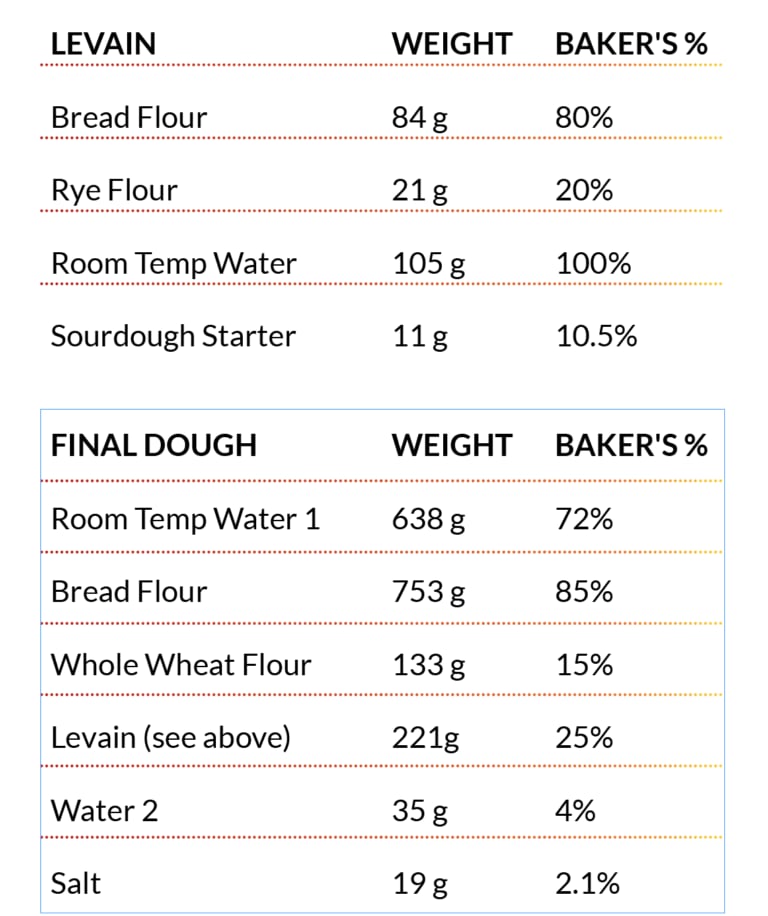
Ingredients
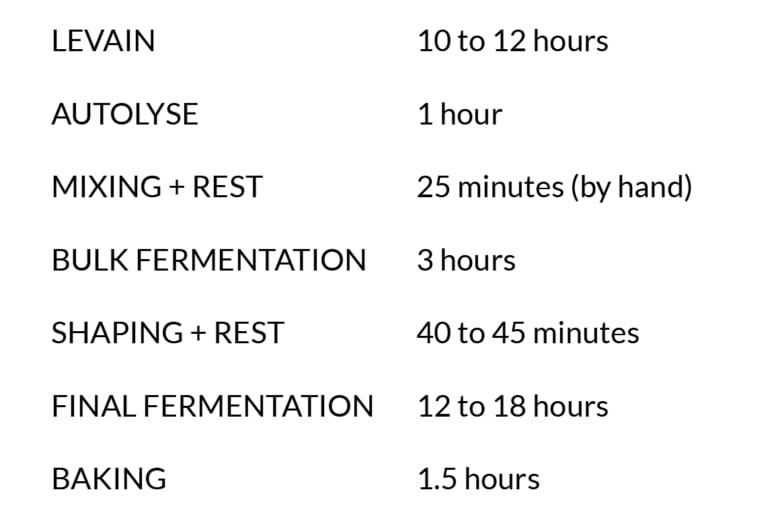
Dough Schedule: 28 to 36 Hours
Instructions
MIXING + FERMENTATION: In a glass jar or plastic container, mix the flours, water and starter until combined. Loosely cover with a lid and ferment at room temperature for 10 to 12 hours, until ripe.
AUTOLYSE: Roughly 1 hour before your levain will be ready, add water 1 to a large mixing bowl or dough container. Add the flours and, using a rubber spatula, start stirring in the center, drawing the water into the flour. When the dough becomes too thick to stir with a spatula, wet your hands and use them to mix the dough, pinching to incorporate any dry patches and using a plastic dough scraper to scrape down the sides of the bowl. Rest, covered, at room temperature while the levain finishes rising.
MIXING + REST: When the levain is ready, add it and half of water 2 to the bowl. Mix with your hands just until combined. Let the dough rest for 20 minutes. Add the salt and the second half of water 2 and, using your hands, pinch the salt into the dough until incorporated. The DDT is 79°F to 81°F (26°C to 27°C).
BULK FERMENTATION: Cover the bowl with a plastic bag or kitchen towel and let the dough rise at room temperature for 3 hours, folding it two or three times in the first 2 hours, roughly 30 minutes apart.
PRE- SHAPING + REST: Divide the dough into two pieces (900 g each). Using a bench knife, round each portion. The bottom should stay flush with the counter, helping to create the tension needed to form a taut ball. Rest, uncovered, for 25 to 30 minutes.
FINAL SHAPING + REST: Shape each ball into a boule or bâtard and transfer each to a floured banneton. Rest, uncovered, for 10 minutes.
FINAL FERMENTATION: Cover with a plastic bag and cold-proof in the fridge for at least 12 and up to 18 hours. The dough is ready to bake when it has risen to about one and a half times the size and is light to the touch. To check, gently press a finger into the dough; it should spring back but leave a slight indent.
PREHEAT THE DUTCH OVEN: About 30 to 60 minutes before you are ready to bake, place a Dutch oven inside your oven, then preheat the oven to its highest temperature. Meanwhile, cut two pieces of parchment paper to roughly the same size as the opening of your Dutch oven. After 30 to 60 minutes, remove the Dutch oven to a heatproof surface.
PREPARE TO BAKE: Remove one banneton from the fridge and gently flip the dough out onto one piece of parchment, then score at a 45-degree angle. Remove the Dutch oven’s lid and carefully place the parchment and dough inside. Place the lid back over the Dutch oven, slightly askew, and quickly spritz about 15 sprays from a water bottle up-ward onto the inside of the lid before closing it fully. Return the Dutch oven to the oven and immediately lower the temperature to 470°F (245°C).
BAKE THE FIRST LOAF: Bake for 15 minutes, then remove the Dutch oven’s lid completely (the dough should be fully risen and just starting to take on colour; if it isn’t, leave the lid on for a few minutes longer for the next loaf ). Bake for 20 minutes, or until the bread is a rich golden brown. The loaf should feel light and the bottom should produce a hollow sound when tapped.
COOLING: Transfer the bread to a wire rack to cool for at least 1 hour before slicing.
BAKE THE SECOND LOAF: Return the Dutch oven to the oven for 15 to 20 minutes to bring it back up to temperature, then repeat steps 9 to 11 for the second loaf.
Chef, culinary teacher, and bread fanatic Matthew James Duffy has over twenty years of experience cooking and baking all over the world—from world-class bakeries and specialty pizzerias to Michelin-starred restaurants, such as Noma, Langdon Hall, and Café Boulud. His new book, Bread Etc. is on sale this fall.