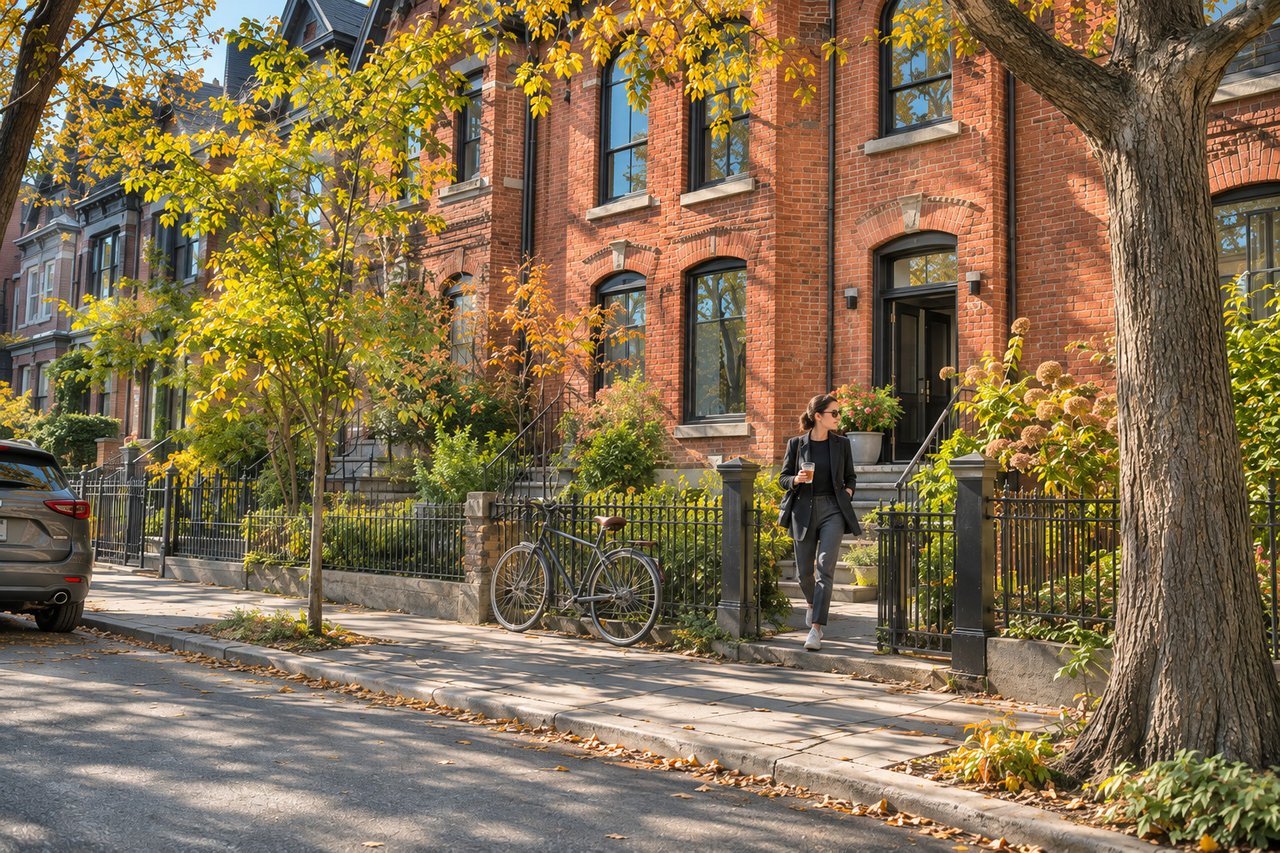
Stand on almost any residential street between Eglinton and Lawrence and count the doorbells. A detached house has one. A row of townhomes has six, each with its own mat and its own opinion about planters, while a boutique condominium keeps a discreet brass panel of names beside the lobby door. The converted house on the corner, which once held a single family and had a very large porch, now has three buttons stacked neatly one above the other.
Those doorbells tell the story of low-rise living in Midtown Toronto. The term covers townhomes, stacked townhouses, boutique condominiums and small walk-ups, usually six storeys or fewer, and describes the homes that sit between the skyline and detached houses.
For years, they were the middle child of Toronto real estate, less photogenic than a glass tower and less storied than a Georgian on a corner lot. Lately, the middle child has started getting the best seat at dinner.
At Harvey Kalles Real Estate, the request arrives in many forms but usually means the same thing. Buyers want a door of their own on a street they recognize, close enough to the central district of Midtown Toronto to walk to the subway, the grocer and a good bakery, yet far enough from the crowds to hear the leaves come down in November.
A City Makes Room for More Doorbells
Planners have a name for this kind of housing, and it is not a romantic one. They call it the missing middle, meaning the range of homes between a detached house and an apartment tower.
Toronto has spent the past few years making room for it. In May 2023, the City adopted citywide permissions for multiplexes of two to four units on residential lots. A year later, it approved townhouses of up to four storeys and apartment buildings of up to six storeys along major streets, a change that is currently under appeal at the Ontario Land Tribunal.
Zoning bylaws seldom quicken anyone's pulse, yet each new permission adds a few more doorbells to the map. A city that long seemed to offer a binary choice, the house or the high-rise, is warming to everything in between. And Midtown, with its subway lines and century of carefully tended streets, is where that shift is easiest to picture.
Who Rings Which Bell
Spend a season showing Midtown homes and a few characters become familiar. Each has decided what they want their days to look like, and each tends to land on a different floor.
The empty nesters often arrive first, usually from a family house a few streets away. The children have moved out, the third floor has quietly become storage, and the gutters have started to take things personally. They would like to keep the front door, the walk to the bakery and a patch of garden for the hydrangeas but would be delighted to hand over the snow shovel.
Then come the couples moving up from a condominium, who loved their suite but have gently outgrown it. They want stairs of their own, somewhere to lean a bicycle and a second bedroom that is more than a generous description of a den.
And there are the people who simply like the city at walking pace. They could live almost anywhere, but they choose a street where the trees are at eye level and the neighbours learn their names long before they learn their suite numbers.
“Low-rise living is the city at walking pace, with the trees at eye level and the neighbours known by name.”
One to Three Storeys: The Townhouse
Ask a townhouse owner what sold them and the answer is usually disarmingly simple. There is a front door that belongs to nobody else, a terrace where growing tomatoes is attempted every June with mixed results, and a place to leave muddy boots that is not a shared corridor.
Stacked townhouses take the same idea and fold it in half, placing one two-level home above another. The format offers a private entrance in a more compact footprint, which suits buyers who want the pleasures of a house without its full roster of chores.
The shared wall, meanwhile, is a small social contract. You learn the hours of your neighbour's piano practice, they learn about your relationship with a six o'clock blender, and by the second winter, the two of you are collecting each other's parcels and trading the number of a reliable snow-removal service.
Four to Six Storeys: The Boutique Building
If the glass tower is a grand hotel, the boutique condominium is the small inn where the person at the desk remembers how you take your coffee. These buildings hold a modest number of suites, which means a calmer lobby, a shorter wait for the elevator and faces that become familiar within a season.
Avenue Road, Yonge Street and Eglinton Avenue each have examples of this scale, many with a café, a florist or a wine shop at street level. Residents tend to trade the rooftop pool for something much harder to install: the sense of belonging to a building with a personality of its own.
The romance does come with paperwork. Before buying into any condominium, ask for the status certificate early and review it with your lawyer. It outlines the building's finances and the rules that will shape your daily life.
Next Door to a Century of Gardens
A Midtown townhouse also comes with remarkable neighbours. Several of the city's most admired residential areas sit a short walk away, and an evening stroll through them costs nothing at all.
Lawrence Park was laid out in 1908, with Blythwood Ravine preserved as parkland along its edges. Landscape architects Howard and Lorrie Dunington-Grubb designed plantings for its streets, parks and many of its private gardens, according to The Cultural Landscape Foundation. Its earliest speculative houses were even built with garages instead of stables, making it one of the more forward-looking addresses of its day.
Lytton Park, tucked west of Yonge and south of Lawrence Avenue, grew up around streetcar service that arrived in the 1880s. Many of its Georgian and Tudor homes were built between 1890 and 1930, on generous lots now shaded by trees that were saplings when the houses were new.
Forest Hill was incorporated as a village in 1923 and joined the City of Toronto in 1967. Its early building rules called for architect-designed homes with a tree in every front yard, a bylaw that still pays dividends every October in red and gold.
Living nearby is a little like holding a membership to a very good garden. You get the canopy, the stonework and the long autumn walks.
The Ten-Minute Life
Midtown's low-rise streets reward people who like to run their errands on foot. Grocers, bakeries, dry cleaners and wine bars line Yonge Street, Avenue Road and Eglinton Avenue, so a forgotten lemon rarely requires a trip in the car.
The rest of the city has moved closer, too. Since Line 5 Eglinton began service in February 2026, its Midtown stations at Forest Hill, Chaplin, Avenue, Eglinton and Mount Pleasant have connected these quieter streets to the subway and to neighbourhoods east and west along the corridor.
For anyone who measures a neighbourhood by its dinner reservations, our guide to the best food neighbourhoods in Toronto is a useful companion for comparing Midtown with the rest of the city.
And then there is the green space. Midtown's parks and ravines, from Sherwood Park to the Kay Gardner Beltline Trail along a former railway line, have a way of making a modest garden seem far more generous than its square footage suggests.
Choosing Your Floor
Each format comes with its own short list of questions. For a townhouse, ask about the age of the roof, who clears the shared laneway and whether the terrace gets morning or evening sun.
For a stacked townhouse or a unit in a converted house, ask how shared elements such as roofs, driveways and gardens are maintained, and how costs are divided among owners. For a boutique condominium, the status certificate is the first document to review, followed closely by the minutes of recent owners' meetings.
A top Toronto realtor with expertise in Midtown can fill in the rest: which side of a street catches the afternoon light, which small buildings have a devoted community of owners, and where the next few doorbells are about to be installed.
A Doorbell of Your Own
Low-rise living offers Midtown buyers a gracious middle path, with a front door, familiar neighbours and the whole city within easy reach. Whether you picture a townhouse near the ravine or a boutique suite above a favourite café, the choice comes down to a pleasantly specific question.
Somewhere between Eglinton and Lawrence, there is a doorbell waiting for your name.
Find yours with the team at Harvey Kalles Real Estate Ltd.