With the boomer generation starting to downsize and passing their furniture down, younger generations are inheriting a slew of what people like to call “brown furniture.” And a lot of them simply don’t know what to do with it in their homes.
The trend in home décor over the past decade or so has leaned heavily toward a minimalist, modern aesthetic, so the introduction of what we like to call “antiques” can leave homeowners a little stumped.
But older furniture has qualities that can be difficult to replicate in something brand new. The warmth of aged wood, the patina of leather, traditional craftsmanship and the little imperfections that come with years of use all add character to a room. Rather than competing with cleaner, more contemporary pieces, these elements can actually make them feel more interesting.
Mixing antiques within a modern canvas is a definite trend we see emerging, and it’s one we stand 100% behind as we’ve been practicing it for decades. This aesthetic creates spaces that feel soulful, collected and ultimately more layered… especially when you mix pieces from more than one era. But we understand that it can be tricky, and sometimes daunting, to figure out how to place these pieces seamlessly into a more modern home.
It is all about the mix.
In our Oxford House project, a beautiful Victorian home in Toronto, we were lucky enough to have clients who already owned some gorgeous antiques and urged us to integrate all of them, and more, into our redesign. It’s a great example of how to master this mix.
In the Great Room of this house, there are a lot of different styles and eras playing off one another. A traditional, worn leather chesterfield sits on a Persian rug alongside a very contemporary glass and walnut coffee table. Two contemporary hide benches sit in front of the fireplace, our clients' cherished family piano is tucked into the corner, and an old armchair was given new life in teal blue mohair. And that beautiful marble fireplace mantel? It was repurposed from an old Toronto home.
The materials are as varied as the eras: leather, richly coloured textiles, dark wood, glass, marble and soft mohair all occupy the same room. Against the richness of the rug, the clean lines and transparency of the glass coffee table feel lighter and more contemporary. Meanwhile, reupholstering the antique armchair in saturated blue mohair gives an older silhouette an entirely new personality. It is a good reminder that keeping an inherited piece doesn’t mean keeping it exactly as you found it.
None of these pieces are from the same period, and that is exactly why it works.
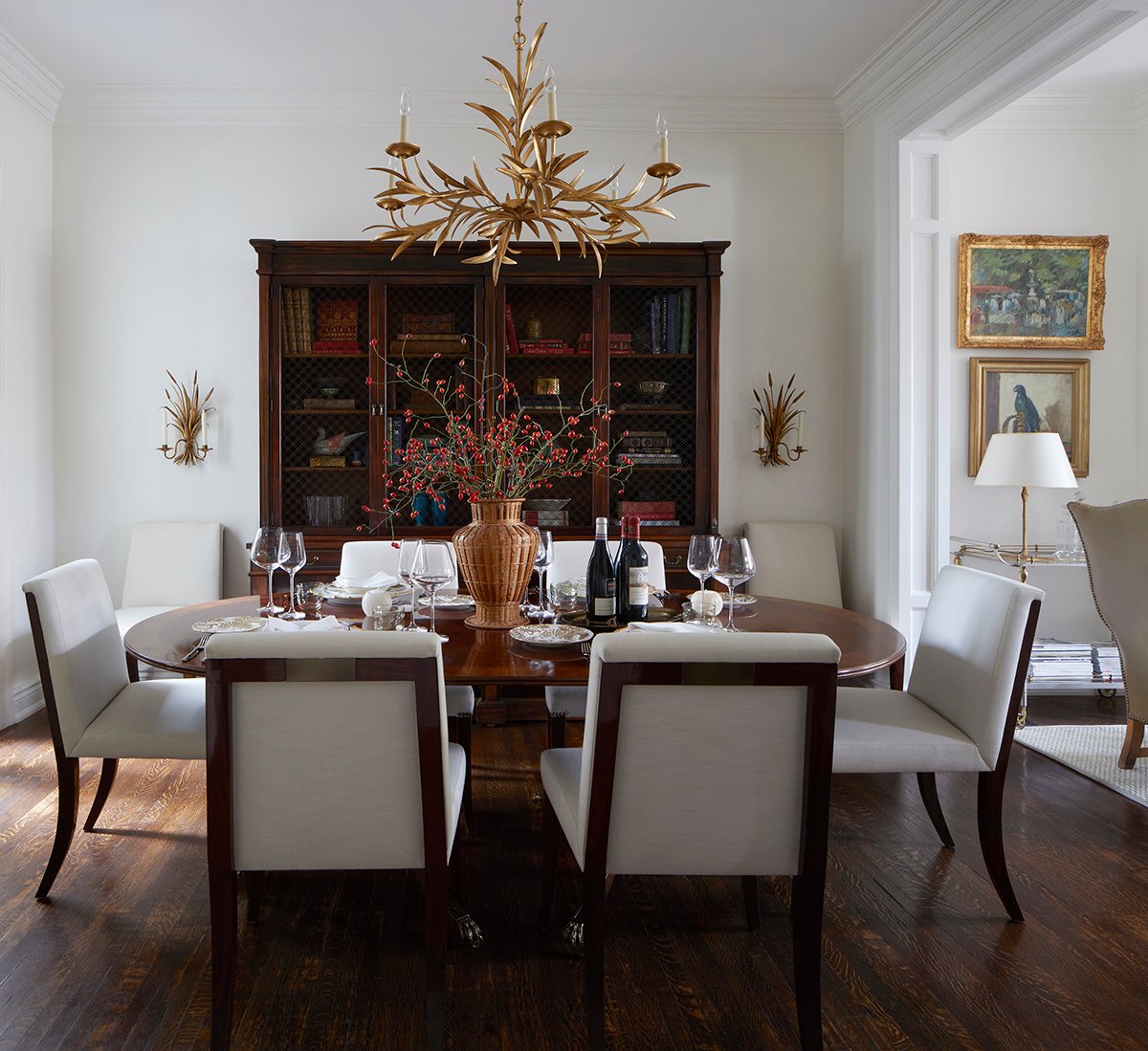
The dining room feels simultaneously traditional and modern. The breakfront was an existing piece and is decidedly traditional, but paired with contemporary dining chairs and a modern light fixture, it looks regal, not stuffy. This is a great example of why you don’t have to get rid of a piece simply because it feels too traditional on its own. Sometimes it just needs new neighbours.
Here, the dark wood of the breakfront gives the room weight and history, while the pale upholstered dining chairs introduce a cleaner, quieter counterpoint. Their simple profiles allow the more decorative antique piece to take centre stage. Overhead, the sculptural light fixture adds another layer, preventing the room from feeling overly formal. Instead of trying to make the breakfront disappear, we allowed it to be the traditional statement in the room and surrounded it with pieces that speak a different language.
In the front hall, we grounded the space with an antique chest of drawers that our clients already owned. We took a pair of their old English armchairs and reupholstered the seats in a contemporary patterned velvet. We then brought in some modern elements: an abstract piece of art by a local Toronto artist, which actually is on a pulley system covering a television, and a dramatic vase filled with branches for a bit of whimsy. A mix of modern and traditional art on the walls finishes it off.
In the home office, an antique desk, table lamp and office chair contrast beautifully with modern steel and wood freestanding bookshelves, a bold painting and colourful rug. Again, it is the contrast that makes this room work.
The substantial wood desk immediately establishes a sense of permanence, but the open bookshelves behind it keep the room from becoming too heavy. The oversized contemporary artwork adds yet another point of contrast, proving that antiques don’t have to live alongside traditional art. In fact, the unexpected pairing makes both feel more distinctive.
The principal bedroom takes the idea one step further, with a bunch of different styles mixed to create an eclectic and warm space. There is a modern farmhouse vibe in the exposed whitewashed ceiling beams, an Art Deco sofa, a contemporary take on a classic canopy bed, and two antique bedside tables in a two-toned walnut.
The slim frame of the canopy bed is a particularly good bridge between old and new. Its shape references a traditional style, but its pared-back form feels current. At the foot of the bed, the green sofa introduces rich colour and softness, while the warm wood bedside tables bring in the patina and character that only older pieces can provide. Together, these contrasting elements make the bedroom feel as though it has evolved naturally rather than being furnished all at once.
There really are no rules saying these things should all go together… and yet they do.
If you want your home to look lived-in, layered and collected, rather than store-bought, remember that getting the mix right takes time and patience. Don’t feel like you need to furnish an entire room, or an entire house, at once. Keep the pieces you love, even if you aren’t quite sure how they fit yet. Reupholster, refinish and repurpose when it makes sense, and don’t be afraid to put something old beside something new.
One helpful approach is to think less about whether pieces are from the same era and more about how their shapes, colours, materials and proportions relate to one another. A room full of antiques can feel heavy, just as a room full of new furniture can sometimes feel a little impersonal. Bringing the two together allows each to balance the other. Give an ornate piece some breathing room, pair dark wood with lighter upholstery, or place something beautifully worn beside something crisp and contemporary.
Also display your stuff! Whether it is old books, a collection of found objects, family photographs or things you have picked up on your travels, these are the details that give a home personality. After all, the best rooms don’t look like they were bought in a day. They look like they came together over a lifetime.
Griffin Houghton is a boutique, full-service interior design firm based in Toronto, Canada. Led by principals Emily Griffin and Stephanie Houghton, we are known for creating unique, colourful and timeless interiors.
Designed by: Griffin Houghton
Photographer: Virginia MacDonald
Styling: Me & Mo