I grew up in Toronto on Tranby Avenue. There was a main street at the end of it, with a strip of good little restaurants. In the fall, when the nights were misty and full of leaves, I can remember the smells of food from the hood exhausts of those restaurants. There was a French-Lebanese restaurant called Arlequin, a few Italian spots, and a steak frites place called L’Entrecôte. As a kid, I felt an intimacy with their kitchens, churning out dinners for the city. I’d imagine the joy and laughter of the dining rooms and the chatter from the little bars tucked on the side. We ate out a lot as a family, and Arlequin was where we went the most.
Inside, we nestled in the booth as a family. It was where my father seemed happiest and most engaged, and we all brought our best selves. At home, he’d retreat to his room, and we’d find our own spots as well. So the restaurants around our house, and the smells coming out of them in the autumn air, both calmed me and exhilarated me at the same time.
My father left when I was 11. I was a shy kid in the middle of my younger brother, Chasen, who was 6 at the time, and my older sister, Amy, who was 14. Being in the middle, I soaked up my mother’s pain, and her utterances over my dad’s absence. I felt responsible for looking after her, and the heaviness that came with that marked the end of my childhood.
I’d meet my dad for lunch in a restaurant once a week, and although it felt strange, those restaurants became my refuge, where I could suspend reality and still feel like my father was a part of the family.
I got my first kitchen job when I was 16, at Arlequin—that French bistro around the corner. They had a lunch takeout counter at the front. I worked there, serving cold salads of curried chicken with apples and ratatouille and hummus and baba ghanoush.
Six months in, the older well-dressed ladies amused themselves by shaming me with the line “Oh, don’t worry, we know it’s your first day” as I continued to stumble about, awkwardly digging into the platter of hummus to get a good scoop into the takeout container and fumbling with the grilled vegetables before poking and mumbling about the cash register to cash them out.
But every once in a while, the owner and chef would let me in the kitchen, hand me a bucket of apricots for jam, and send me to cut and pit in the driveway by the garbage. Later on, he’d come out and scream at me for being back there, until he realized he’d asked me to be.
It wasn’t much to begin with, but I got to go behind the curtain and walk through the bustling clash and bang of the kitchen. The fiery-hot line was the first thing you saw, with its big grill and the rolling ceiling heat of the salamander, the lit stoves with sizzling pans, the plates clattering up with steak frites and rabbit Dijonnaise, and the smells wafting out.
For a moment, I was part of the frenzy of movement and dance, and I felt a reverence and excitement for what they did. I grew fond of the chef, Chris Mathias, and came to call him a friend. Just having the chance to walk through the kitchen and grab the apricots from the fridge was enough for me to tell myself I’d made it further than I could have imagined.
It was only a beginning, but it lit the path that would shape the rest of my life in kitchens. What follows is where that path has led, and the dishes that defined it.
Sichuan Chicken Club Sandwich
Makes 2 sandwiches
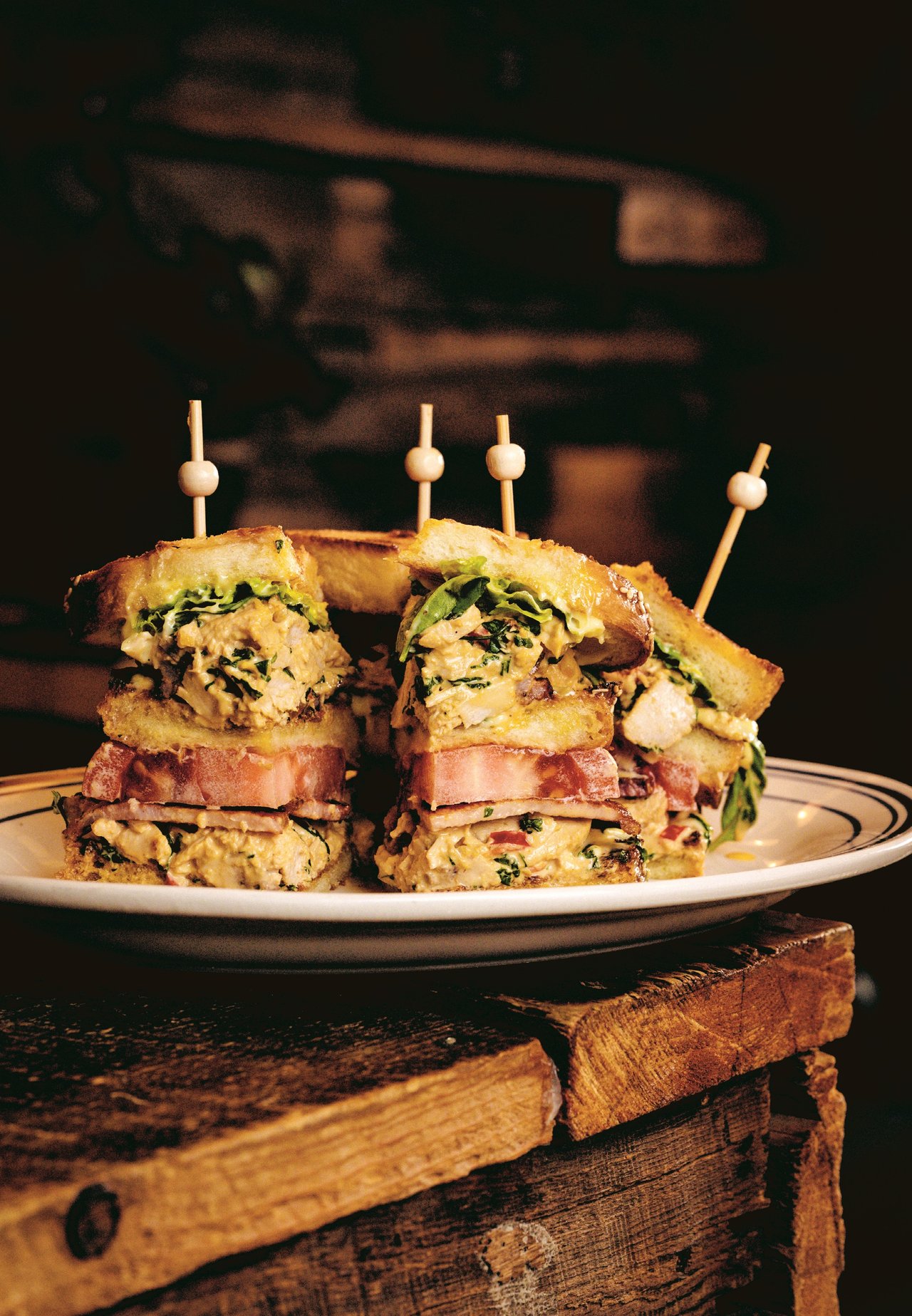
We used to make these at Côte de Boeuf with the leftover roast chickens. We’d pull the meat and toss it with sesame oil, soy, sambal, lime juice, and Thai basil. It turns into a bold, punchy chicken salad that forms the base of the sandwich. Layer it with bacon, tomato, lettuce and toasted white bread, and you’ve got a proper club. It’s the kind of food you make on a lazy Sunday with whatever roast chicken you’ve got lying around.
INGREDIENTS
12 oz (340 g) pulled roast chicken
Juice of 1 lime
1 Tbsp soy sauce
1 Tbsp mirin (I like Honteri brand)
1 Tbsp mayonnaise
1 tsp sambal oelek
½ tsp toasted sesame oil
Salt and ground black pepper
Handful of Thai basil leaves, chopped
8 slices bacon
6 slices white bread
Softened butter
1 tomato, sliced
Butter lettuce leaves
TABAC HACK
If you have spicy mayo in your pantry, sub it in for the sambal, mirin, and mayo.
METHOD
Place the pulled chicken in a medium bowl. Add the lime juice, soy sauce, mirin, mayonnaise, sambal oelek, and sesame oil. Season with a pinch of salt and a few cracks of black pepper. Mix everything thoroughly. Gently fold in the Thai basil. Taste and adjust the seasoning, if needed.
In a pan over medium heat, cook the bacon until crisp. Transfer to a paper towel–lined plate to drain.
Toast the bread until golden brown. While the toast is still warm, spread a thin layer of butter on one side of each slice.
To assemble, place one slice of toast on a cutting board, buttered side up. Add a generous scoop of the chicken mixture, spreading it evenly. Top with two slices of bacon and a few slices of tomato. Place a second slice of toast on top, buttered side up. Top with another scoop of chicken and some lettuce. Finish with the final slice of toast, buttered side down. Press the sandwich gently to hold everything together, and slice into four quarters. Repeat with the remaining ingredients to make the second sandwich.
Teo Paul is the acclaimed chef and owner behind four celebrated restaurants: Union, Côte de Boeuf, Heart’s Tavern, and Le Tambour. After honing his craft in Paris and Piedmont, Teo returned home to Toronto, where Union became a defining landmark of the Ossington dining scene. His restaurants have been featured in The Globe and Mail, Toronto Life, the Toronto Star, NOW Magazine, Canada’s 100 Best, and the Michelin Guide.
Excerpted from Done Right by Teo Paul. Copyright © 2026 Teo Paul. Photographs by Daniel Neuhaus. Published by Appetite by Random House®,
a division of Penguin Random House Canada Limited. Reproduced by arrangement with the publisher. All rights reserved.