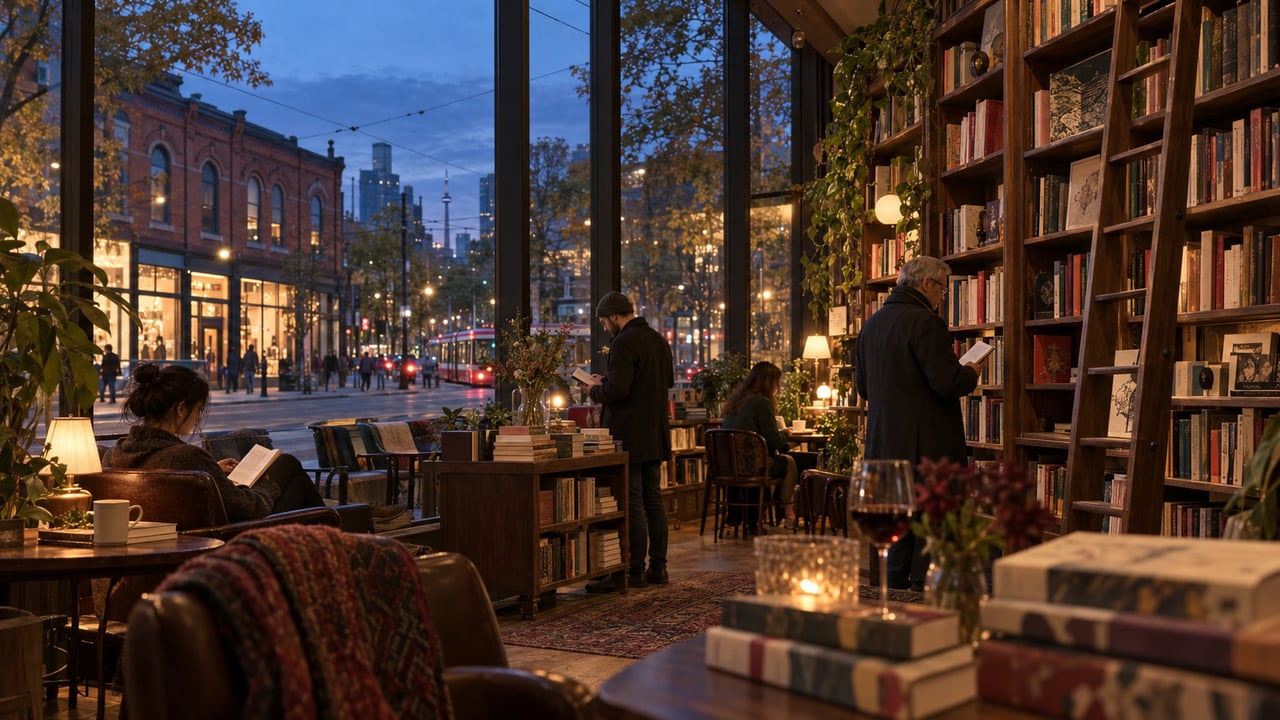
From a children's institution on Mount Pleasant to a bookstore-slash-cocktail-bar in Mirvish Village, a tour of the shops keeping Toronto's reading culture alive.
By Sara Alba
There's a particular kind of quiet that settles over a good bookstore: conversation drops to a murmur, recommendations pass between strangers, and the rest of the city seems to pause at the door. Toronto has always known that feeling. Its independent bookstores aren't interchangeable retail spaces; each reflects the readers, streets, and communities around it.
From children's stories and culinary discoveries to comics, literary fiction, and a new cocktail-bar concept, these shops show how broad Toronto's reading culture has become. Together, they reveal why physical bookstores continue to matter, even in an age of online ordering, audiobooks, and BookTok recommendations.
Mabel's Fables: A Toronto Institution for Young Readers
On Mount Pleasant Road, Mabel's Fables has built its identity around books for children, young adults, families, and educators. Its colourful selection invites young readers to browse, while its knowledgeable staff help parents find books suited to different ages, interests, and reading levels. More than a shop, it represents the kind of neighbourhood resource that can become part of a family's routine for years.
The long-term relationship between a bookstore and its community is especially visible in established residential areas. Much like the bookshops associated with The Annex, Mabel's Fables demonstrates how an independent business can help shape the rhythm and identity of a neighbourhood.
Good Egg: Where Food and Books Meet
Good Egg takes a more specialized approach. Located in Kensington Market, the shop brings together cookbooks, food writing, kitchen goods, gifts, and playful finds for curious home cooks. The result feels closely connected to its surroundings, where markets, restaurants, bakeries, and independent retailers have long made food part of the neighbourhood's cultural identity.
Good Egg also shows that a bookstore doesn't need to serve every kind of reader to become a destination. A clear point of view can be its greatest strength. Visitors may arrive looking for a cookbook and leave with a new ingredient, a useful kitchen object, or an idea for their next dinner.
Silver Snail and the Enduring Appeal of Comics
Silver Snail has long given Toronto's comic-book readers a place of their own. Its shelves span comics, graphic novels, collectibles, and pop-culture favourites, welcoming both committed collectors and newcomers looking for an accessible entry point. Stores like this remind us that literary culture extends well beyond the traditional novel.
Comics and graphic storytelling bring together writing, illustration, fandom, and community. That combination gives Silver Snail a distinct role within Toronto's arts and culture scene and reflects the specialized knowledge that independent retailers can offer in a way larger, general-purpose stores often can't.
Type Books and Queen West's Literary Character
Type Books is known for thoughtfully selected fiction, nonfiction, poetry, art books, and children's titles. Its Queen Street West location feels naturally connected to the galleries, independent businesses, and creative energy surrounding it. For readers exploring Queen Street West's vibrant culture, stopping to browse the shelves can become part of the neighbourhood experience rather than a separate errand.
The store's appeal rests partly in curation. Instead of presenting every available title, independent booksellers can guide readers toward books they may not have found on their own. That element of discovery remains one of the strongest reasons to visit a physical shop.
Ben McNally Books: A Downtown Destination
Ben McNally Books brings an elegant, literary atmosphere to downtown Toronto. Its collection covers fiction, history, biography, art, photography, cookbooks, and children's literature, supported by staff recommendations and author-focused programming. It offers office workers, residents, and visitors a calm place to browse within the city's busiest core.
Its presence also reflects the range of Toronto's bookstore neighbourhoods. Some thrive on lively commercial streets, while others become quieter destinations near areas such as Yorkville. Each succeeds by responding to the people who spend time nearby.
Book Bar Brings a New Format to Mirvish Village
Book Bar is the newest addition to this wider story. Opened on June 27, 2026, at 600 Markham Street in Mirvish Village, it combines an independent bookstore with coffee, wine, cocktails, light food, and cultural programming. Guests can browse and buy books, settle into a reading nook, or meet friends for a drink without leaving the two-level space.
The concept feels well suited to Toronto's cozy season, but its larger appeal is social. Book Bar treats reading as something that can lead to conversation and shared experience. In doing so, it joins the return of Toronto's third places: welcoming rooms outside home and work where people can spend time without rushing.
Why Toronto's Independent Bookstores Still Matter
These stores differ in audience and atmosphere, but they share an ability to turn browsing into a local experience. Digital recommendations may introduce readers to a title, yet a physical bookstore offers something an algorithm can't fully reproduce: a bookseller who understands the shelves, a chance discovery, and a room shaped by the community around it.
They also act as neighbourhood time capsules, preserving familiar rituals while adapting to new interests and formats. From the family focus of Mabel's Fables and the culinary personality of Good Egg to Silver Snail's comic culture, Type's thoughtful curation, Ben McNally's downtown polish, and Book Bar's hospitality model, Toronto's literary spaces continue to evolve without losing their sense of place.
That relationship between local businesses and neighbourhood identity is something the top real estate agents at Harvey Kalles understand well. Toronto's best-loved streets are shaped by their homes, architecture, and independent places that keep residents connected.