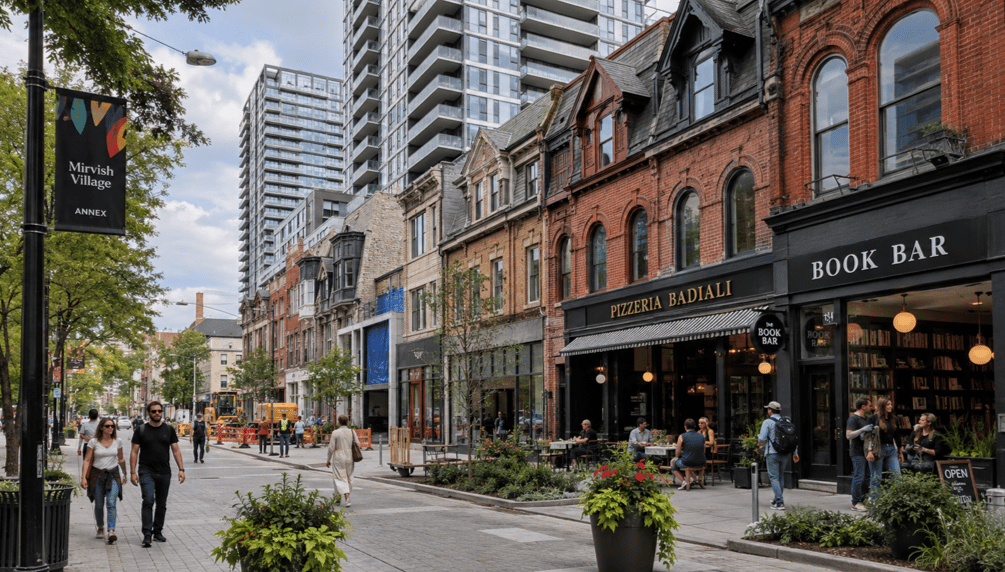
On a Tuesday afternoon in August, the patio outside Pizzeria Badiali is full. There's a line at Book Bar's espresso counter. Kids are cutting laps around the new planters at Honest Ed's Park, and somewhere past the excavators still parked mid-block, a table of four is arguing about whether the gelato place has opened yet. It hasn't, not quite.
This is Markham Street in August 2026: not a rendering, not a leasing brochure, not a "coming soon" sign. Actually here. For most of the last decade, that sentence would have been impossible to write.
Markham Street, tucked one block west of Bathurst at the southwest corner of Bloor and Bathurst, has spent years behind construction fencing while timelines slipped and renderings aged. CBC reported on August 16, 2026 that construction is now expected to wrap this fall — but the commercial side will take longer: only 48 of the roughly 106 planned commercial units had been leased at the time of that reporting.
The street is open, but the neighbourhood is still filling in around it. This is what Markham street looked like before, and what it looks like today:
What Was Here Before
Markham Street didn't need a redevelopment to have a personality. Starting in the 1960s, its Victorian houses filled up with galleries, studios and bookshops, earning the block a reputation (the Markham Street Art Colony) as a bohemian pocket of the Annex long before “mixed-use” was a term anyone used in a planning meeting.
It shared the corner with something louder: Honest Ed's, the discount department store Ed Mirvish opened in 1948, which was flashing bulbs, hand-lettered signs and a bargain-bin chaos that felt entirely unbothered by the idea of curb appeal. When it closed on December 31, 2016, after nearly seven decades, it left more than an empty building. It left a gap in one of the few parts of downtown Toronto that had always refused to behave itself.
That's the bar the new Mirvish Village must clear… not recreating Honest Ed's as a theme park but giving the corner back some of the same unruly, independent energy. Restaurants, bookstores, and gathering spaces are moving into the restored houses again. Whether that adds up to the same spirit is still an open question. But for the first time in years, there's enough happening on Markham Street to ask it.
Walking It Now
The street reopened to the public in May 2026, and a handful of the businesses that used to exist only as names on a leasing plan are now places you can walk into.
Pizzeria Badiali opened its second Toronto location at 581 Markham Street that same month, inside the restored Victory House, formerly home to the long-running Victory Cafe. It's done the one thing a construction site can never do on its own: given people who have no professional interest in real estate or architecture an actual reason to show up.
A block away, at 600 Markham, Book Bar opened in June, a three-storey bookstore-and-wine-bar spread across another restored heritage building. It's the kind of tenant Mirvish Village has been promising since the beginning: specific enough to feel like a place rather than a retail podium, and good at the very practical job of getting people to linger longer than seven minutes.
Then in July, Honest Ed's Park opened at the center of the development… the first of the project's public spaces to stop being theoretical. It's already hosting programming and events, which matters more than it might sound. For years, “future park” was a phrase that appeared in renderings and nowhere else.
Add a Bank of Montreal branch, an LCBO, a Niagara College Canada campus and a Pet Planet, and the street starts to look genuinely occupied. It's still uneven — some stretches feel finished, others like construction hoarding with better lighting — but Markham has moved past the point where two open doors were doing all the work.
What's Still Behind the Glass
Not everything on the tenant list has opened its doors yet.
Pasta Basta is slated for 595 Markham Street and, as of August 17, still lists Mirvish Village as “coming soon.” Blackbird Baking Co. is scheduled to open at 610 Markham in September, bringing another established Toronto name to the strip. Cremma Gelato has been announced for the development and remains unopened. The paper is still up on a few windows.
Two larger concepts are also still under construction. The Kitchen, roughly 19,000 square feet of food, drink and gathering space with multiple vendors and live programming, is designed to be a destination rather than another food court. Honest Ed's Alley, meanwhile, is a Tokyo-inspired pedestrian laneway built around 25 micro-retail units, meant to give smaller operators a way in without the cost or commitment of a conventional storefront.
The Grocery Store Nobody's Naming
The biggest change in the latest reporting isn't a new opening — it's a cancellation. Bestco Fresh Foods had been announced as the project's grocery anchor. That's no longer happening: CBC reported that Bestco's lease was terminated, and neither Bestco nor Peterson, the project's developer, would tell CBC why.
Peterson says a replacement grocery tenant is among several new tenants expected to be announced soon, so the honest version of this story is simple: Mirvish Village is still expected to have a grocery store. It just doesn't have one yet.
The Numbers Behind the Storefronts
The ownership structure has shifted too. Westbank originally led the redevelopment after acquiring the Honest Ed's site in 2013, with Peterson as a project partner. In 2026, Peterson bought out Westbank's ownership stake and took over the project outright, while Westbank stayed on for property management. Peterson now says construction will wrap this fall — a firmer timeline than the “summer 2026” floated in earlier updates, though construction finishing and storefronts filling up are, it turns out, two entirely separate timelines.
The physical bones are substantial: ten restored heritage houses anchor the pedestrian-priority stretch of Markham Street, while the wider development totals roughly 890 purpose-built rental homes and 200,000 square feet of commercial space. That's not a facelift on the old Honest Ed's corner. It's a new piece of city being grafted onto an old one, which helps explain why, commercially, it's still only about 45 per cent leased.
The residential side tells a similar half-finished story. Peterson told CBC that around 450 rental units have already been leased, about 100 available units remain unclaimed, and roughly 320 more are still awaiting occupancy permits, with those units expected to be released over the following three months. Mirvish Village, in other words, is still acquiring the population its restaurants and shops are counting on. Judging the finished commercial ecosystem in August 2026 is a bit like reviewing a dinner party while half the guests are still in the elevator.
What It Means
None of this guarantees that Mirvish Village reshapes the surrounding real estate market just because the paving stones are attractive and there's a wine bar now. Cities are more stubborn than that.
But the fundamentals are unusually strong: walkability, Bathurst Station across the street, active street-level retail, real public space and a neighbourhood with history already attached. Those are the things that tend to make a place last. Mirvish Village has all five, alongside the new transit lines already reshaping how buyers think about connectivity across the city. What's still unresolved is how well the commercial side catches up to them.
Toronto has plenty of models for what that can look like, from the settled retail rhythm of Bloor West Village to the restless reinvention of the culture of Queen Street West. Markham Street's version arrives with an advantage neither of those had to build from scratch: it's already stitched into the Annex, a short walk from Kensington Market and Chinatown, and sitting on top of one of the city's busiest transit lines rather than waiting for one to arrive.
People buying into a neighbourhood like this aren't really buying square footage. They're buying the walk to coffee, the bookstore around the corner, the subway they don't need a car to reach, and the sense that the block has an identity beyond its postal code. This is the same instinct that draws buyers toward Toronto's architecturally significant streets and the Toronto neighbourhoods that look straight out of a film. Markham Street already had that identity, built over decades by an art colony and a department store that refused to be tasteful.
That's the kind of distinction — what's happening on a street versus what's still just a rendering — that matters when you're buying into a neighbourhood. It's also where local knowledge counts: the best real estate agents in Toronto can help buyers separate what's already taking shape from what's still a promise. It’s worth walking the block yourself before deciding either way.