Image by Creator: Jose San Juan Jose San Juan | Credit: City of Toronto
Toronto has a reputation for being a city that works hard. There are glass towers, packed commutes, and ambitious people with somewhere to be. All of that is true. But wander into the right corner of the city on a warm June afternoon, and you will find something else entirely: roses older than most of the buildings nearby, lily ponds so still they look painted, and gardens tended with the kind of patience that has nothing to prove.
The public gardens in Toronto are among the most underappreciated pleasures this city offers. They are free, or nearly so, and are gorgeous across every season. These gardens have a way of reminding you that the best things in this city are not always the loudest ones.
Here is where to go:
Toronto Botanical Garden and Edwards Gardens
Edward Gardens sits at the northeastern edge of the city where the ravine system begins to take over. It is, without question, one of the finest formal gardens in the country. Twelve hectares of curated landscape run along Wilket Creek, with rock gardens, rose collections, perennial borders, and a stream that moves through the property.
The Toronto Botanical Garden occupies the same site, and together they function as a kind of horticultural campus: part public park, part educational centre, part quiet revelation for anyone who assumed that parks and ravines in Toronto were mainly for dog walking and weekend jogs.
The rhododendron collection blooms in May with an intensity that stops people mid-sentence. The cutting garden is particularly beautiful in late summer. The Teaching Garden, updated constantly by the botanical team, demonstrates what is truly possible in a residential outdoor space. This matters more than people tend to admit when they are standing inside it.
The neighbourhood that surrounds Edwards Gardens is worth noting. Buyers in this part of the city have long understood that access to the ravine system is not a nice-to-have. It is one of the most stable and enduring forms of residential value Toronto offers, and it does not show up on a features list. It just becomes part of how you live.
Allan Gardens Conservatory
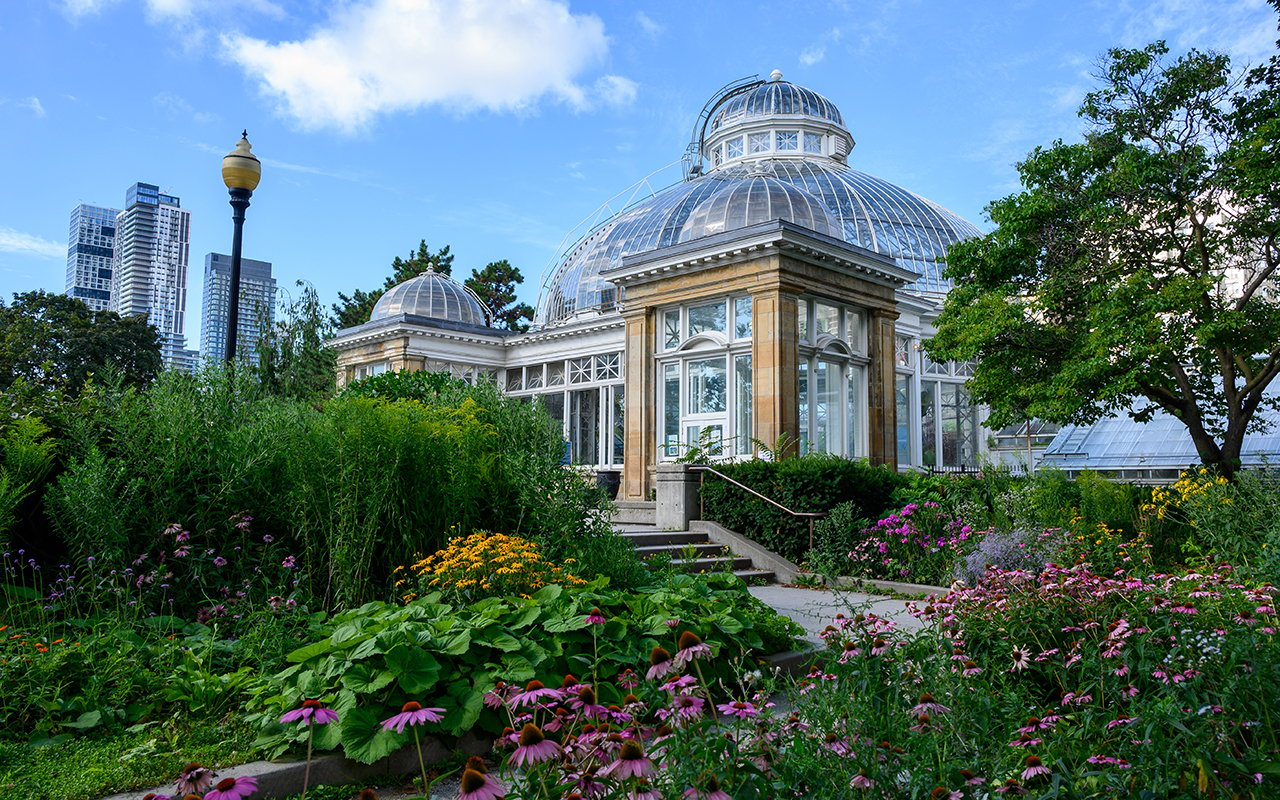
Allan Gardens is downtown Toronto's oldest park, and the Palm House at its centre has been standing since 1910. That greenhouse, with its soaring Victorian dome and cast-iron ribs, houses one of the finest public tropical collections in the country: palms, cacti, orchids, begonias, ferns, and flowering plants arranged across six greenhouses that stay warm and lush even in the bleakest weeks of February.
There is something very Toronto about Allan Gardens. It sits in a neighbourhood that has changed enormously over the decades, and it has absorbed all of it without losing its essential character.
The conservatory is free to enter, and it’s open every day of the year. It has become one of the city's great third places in Toronto, somewhere between home and work where the city genuinely exhales.
Allan Gardens is also a strong argument for why the best gardens in Toronto tend to cluster in neighbourhoods with genuine history. They were built by people who were thinking about permanence, and that intention is still tangible.
Casa Loma Gardens
Most people visit Casa Loma for the castle and leave without spending much time in the gardens below it. However, the five-acre estate gardens that Sir Henry Pellatt commissioned at the same time as the main house are a significant part of Toronto’s horticultural history. They reward the people who slow down.
The formal gardens on the south side of the property are planted with roses and perennials in symmetrical beds that frame the view back toward the city. The conservatory, connected to the main house by an underground tunnel, was designed as a private exotic garden and still carries that atmosphere. And the kitchen garden, recently restored, gives a sense of what it meant to maintain a working estate at that scale in the early 20th century.
Casa Loma is a good example of something Harvey Kalles Real Estate has always believed about this city: architecturally significant streets in Toronto carry something that goes beyond their square footage. The gardens here are inseparable from the architecture. They were designed to be looked at from specific windows, to provide specific views, and to make the house feel like it belonged to the landscape and the landscape to the house. That relationship between a home and its outdoor environment is still one of the most compelling things a property can offer.
High Park and Its Seasonal Gardens
High Park is Toronto's largest public park, and it contains multitudes. The cherry blossoms in the lower park draw thousands of visitors every spring, often with a wait for parking and a crowd around Hillside Gardens. But go on a weekday in late April ,or come back in July when the formal perennial beds are at their peak, and you will find something considerably more serene.
The hill gardens near Grenadier Pond are planted with native species and managed in a way that changes dramatically with the seasons. In October, the colour along the eastern ravine slopes is remarkable. In March, the witch hazel blooms before anything else is willing to. In June, the wild gardens around the pond edge look almost tropical.
The neighbourhoods that border High Park, particularly Roncesvalles, Bloor West Village, and Swansea, have long commanded a premium that anyone looking at the real estate data can verify. The park is a meaningful part of why people choose this area.
The Alexander Muir Memorial Gardens and Lawrence Park
There is a garden at Yonge Street and Lawrence Avenue that most Torontonians drive past without thinking much about it. The Alexander Muir Memorial Gardens are formally planted, beautifully maintained, and were designed in 1951 as a transition between the activity of Yonge Street and the ravine landscape that begins just behind them.
Muir was the schoolteacher who wrote The Maple Leaf Forever in 1867, and the gardens named for him are planted with maples and maintained by the City with a seriousness that reflects their commemorative purpose.
What the gardens also do is mark the entrance to one of Toronto's most distinguished addresses. The Lawrence Park garden suburb, established in the early 1900s, was designed around the idea that residential life should be embedded in a landscape, not imposed upon it. The streets curve to follow the natural topography. The lots are generous. The ravine lots back onto Sherwood Park, which connects to a trail system that feels nothing like the city it sits inside.
For buyers interested in Toronto neighbourhoods where outdoor beauty is genuinely built into the fabric of the community, Lawrence Park remains one of the most compelling addresses in the country.
Hidden Garden Gems Worth Seeking Out
Not every beautiful garden in Toronto has a sign at the entrance.
Humber Bay Butterfly Habitat
On the western waterfront is a native plant garden that was designed specifically to support monarch butterfly migration. It is modest in scale and extraordinary in purpose, and it is genuinely beautiful from midsummer through October.
Rosetta McClain Gardens
In Scarborough, sit on a bluff above Lake Ontario with views that stop people in their tracks. The formal gardens are maintained by the City, and the property also includes a rock garden, a rose collection, and a long pergola walk. It is the kind of place that belongs on any comprehensive list of the best gardens in Toronto and frequently gets left off.
The Guild Park Estate
In Scarborough, there is something else entirely different…a sculpture garden populated with architectural fragments saved from demolished Toronto buildings and displayed on a shaded ravine property that once served as an artists' retreat. It is historically rich, atmospheric, and completely unlike anything else the city has to offer.
Ernest Thompson Seton Park
Tucked along the Don Valley, you’ll find the spot where Toronto's hikes in the GTA and formal gardens overlap. The wildflower meadows along the river valley are planted rather than simply maintained, and in late spring, the colour along the east bank of the Don is exceptional.
Why This Matters Beyond the Walk
Toronto's public gardens are not a separate category from the question of where to live. They are embedded in it. The most beautiful gardens in Toronto are situated in, or adjacent to, the city's most enduring neighbourhoods.
People choose where to live for reasons that are sometimes difficult to articulate at a kitchen table. They talk about schools and transit and commute times. But what they are often describing, underneath all of that, is how they want their daily life to feel. Maybe, they want to walk somewhere beautiful in the morning or want a reason to be outside. Perhaps they crave a neighbourhood that offers something that cannot be replicated on a feature sheet.
The gardens are part of that. They always have been.
At Harvey Kalles Real Estate, our luxury real estate agents understand that a home does not end at the front door, or even at the property line. It extends into the street, the neighbourhood, the ravine behind it, and the garden that somebody planted a hundred years ago with the intention that it would outlast them. We help people find their way into the city's most beautiful addresses, and we take that responsibility seriously.
If you would like to explore what it looks like to live near this kind of beauty, we would be glad to start that conversation.
Harvey Kalles Real Estate Ltd. has been guiding discerning buyers and sellers through Toronto's neighbourhoods for over 60 years. Discover our current listings and neighbourhood guides at HarveyKalles.com.